Download a free PIM RFP template
Sitation’s PIM RFP template is a free, vendor-neutral Word document for choosing a product information management platform. It gives you requirement tables, response codes, scripted demo scenarios, a five-year pricing table and example scoring weights, ready to adapt and send to your shortlist.
- Vendor-neutral: no platform is favored or scored
- Word format, ready to edit
- Built from Sitation’s platform selection work
Get the template
Enter your details and we will email you the template.
Sent to your inbox in a few minutes. No cost and no obligation.
What the template covers
Twelve sections, each with guidance notes to delete before you send it, and a closing guide to running the selection.
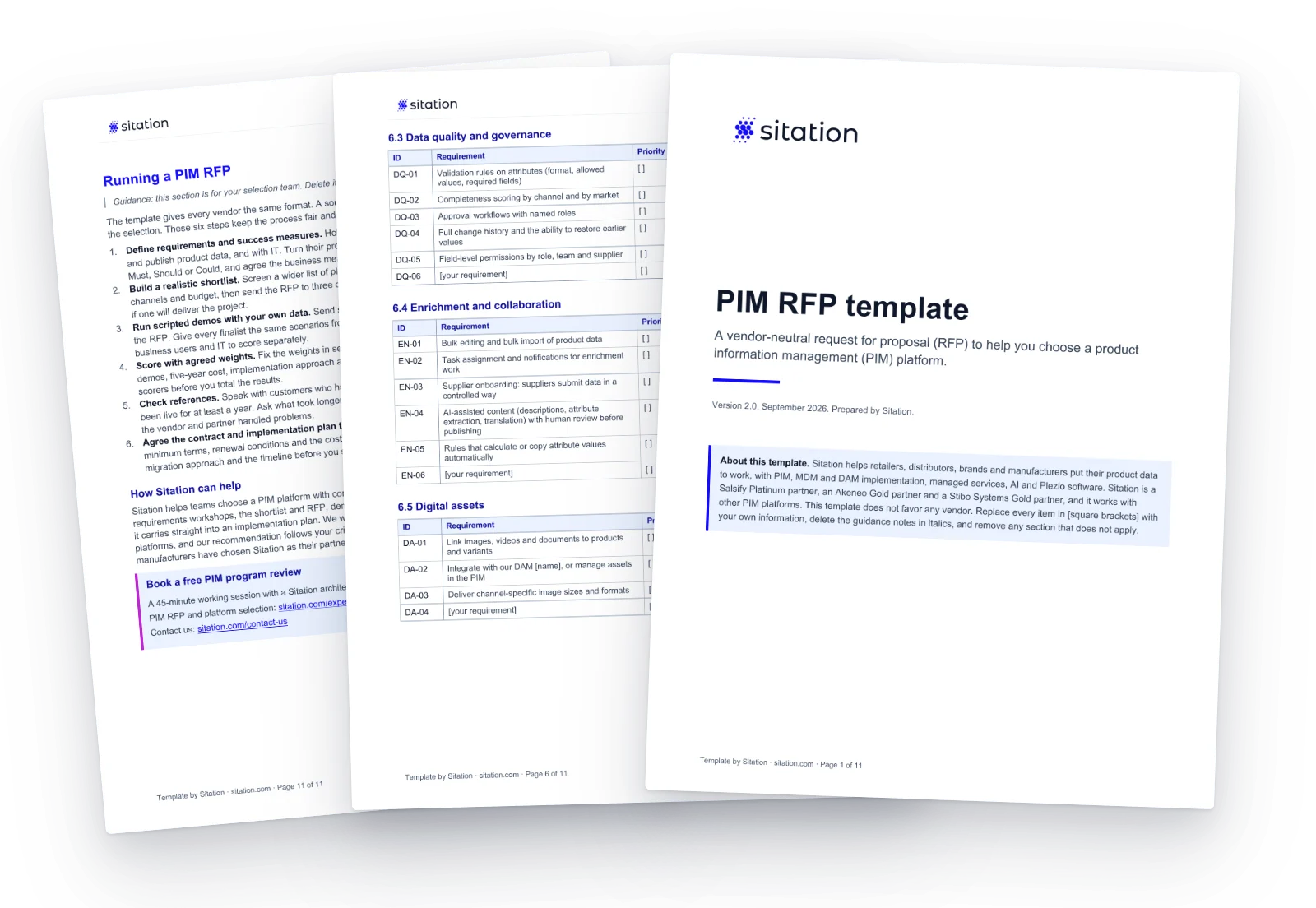
- Instructions to vendors: timeline, questions, response format and confidentiality.
- Project overview: business goals with measures and baselines, current state, scope and constraints.
- Product data inventory: SKUs, variants, attributes, languages, assets and standards such as GS1, ETIM, ACES and PIES.
- Systems, channels and users: tables for integrations, channels and the roles that will use the PIM.
- Requirements: about 40 starting requirements across data model, data quality, enrichment, assets, syndication, APIs, security and support.
- Response codes and priorities: Standard, Configuration, Custom, Roadmap or Not supported, and Must, Should or Could.
- Scripted demo scenarios: six scenarios to run on your own products instead of a standard demo.
- Implementation approach: questions for the vendor and the implementation partner.
- Pricing template: a five-year table so every vendor prices the same assumptions, including the cost of growth.
- Evaluation criteria: example weights to agree internally before responses arrive.
- Running a PIM RFP: best practices for the selection, from defining requirements and success measures to the shortlist, scripted demos with your own data, weighted scoring, reference checks, and the contract and implementation plan.
For the full selection process, from defining outcomes to comparing total cost of ownership, read our guide How to choose a PIM. Sitation can also help you run the selection. Our PIM RFP and platform selection team works through each step with you, and a free PIM program review is a good place to start.
How to use it
Describe your products and systems
Complete the overview, inventory, systems and channel sections first. Vendors can only give useful answers when they understand your data.
Rank the requirements
Mark each requirement Must, Should or Could and keep the Must list short, so the responses separate the vendors.
Send it to three or four vendors
Screen a wider list against your Must requirements, then invest the time in scripted demos and references with the finalists.
Frequently asked questions
What is a PIM RFP?
A PIM RFP (request for proposal) is a document that describes your product data needs and asks PIM vendors to explain, in a standard format, how their platform meets them and what it will cost.
Is the template tied to a particular PIM vendor?
No. Sitation is a Salsify Platinum partner, an Akeneo Gold partner and a Stibo Systems Gold partner, and it works with other platforms. The template does not favor or score any vendor.
Can Sitation help us run the selection?
Yes. Our PIM RFP and platform selection work covers requirements workshops, the shortlist and RFP, scripted demos and a total-cost comparison.
Do we need an implementation partner in the RFP?
It helps. The template includes implementation questions to send to the vendor and to any partner who would deliver the project.
Want help with your platform selection?
Our PIM RFP and platform selection work covers requirements workshops, the shortlist and RFP, scripted demos and a total-cost comparison, and it carries straight into implementation when you are ready.
