Change Management : Transforming into an AI Organization
March 5, 2026
This blog is the fifth of a series of blogs covering the fundamentals of organization wide AI platform deployment and adoption
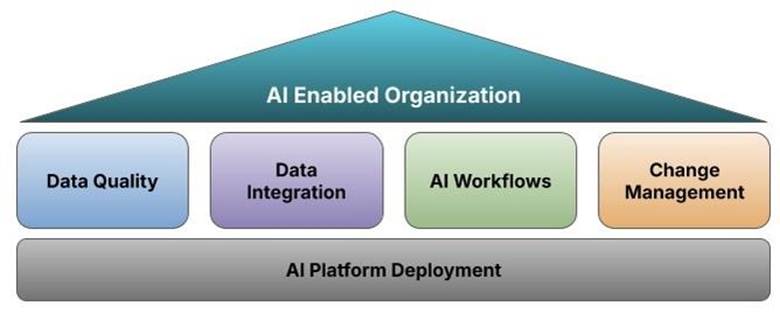
In the previous blogs, we covered the four core aspects of AI adoption in the organization for delivering value:
- Data Quality
- AI Algorithms
- Data Integration
- AI Workflows
In this final blog, we will cover the fifth aspect and crucial role of effective change management as a prerequisite in the AI enabled organization.
Various standard industry frameworks can be used for enacting change management for AI enablement in organizations, focusing on a graded and seamless adoption by various divisions in the organization. Some prospective frameworks for change include: the Prosci ADKAR Model, Kotter’s 8-Step Process for Leading Change, Lewin’s Change Management Model or McKinsey 7-S Framework, among others.
Regardless of the selection of the framework, there are some common elements that establish the foundation for AI change management and are explored in this blog. The objective is to educate prospective adopters on the elements of change that are expected as part of any transformation program. The key foundational elements for change management are three-fold:
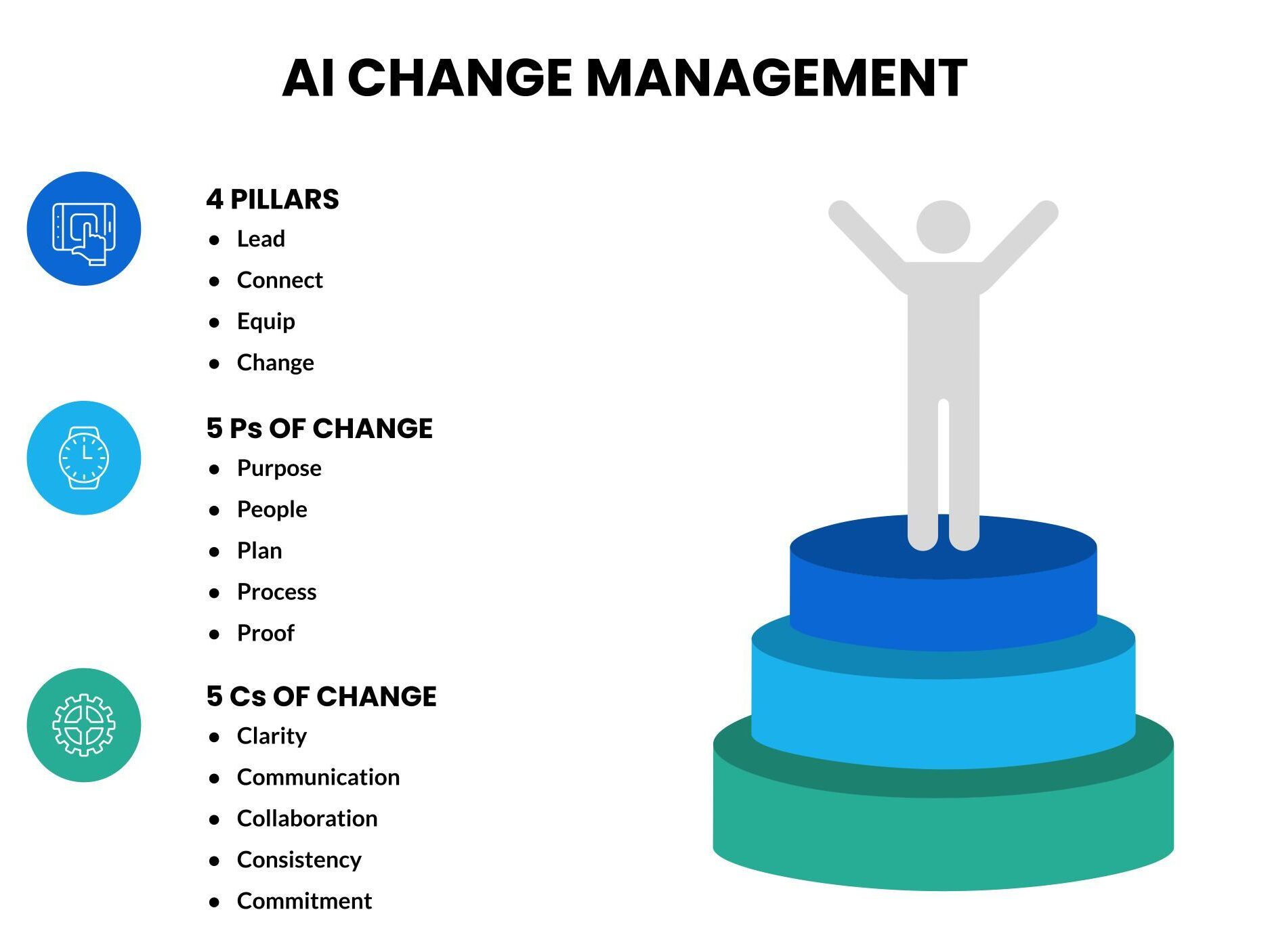
- 4 Pillars: Lead, Connect, Equip, and Embed.
- 5 P’s of Change: Purpose, People, Plan, Process, and Proof.
- 5 C’s of Change: Clarity, Communication, Collaboration, Consistency, and Commitment.
4 Pillars
Expanding on the 4 pillars to enact change and aligning that with the AI implementation strategy for the organization requires due diligence to four areas
Lead – Identify the leadership team (AI Council) and executive sponsorship for the transformation and enablement strategy. This can be further classified into the division level sponsors with clear objectives in the level and timeline of adoption. This is a crucial pillar and should be prioritized first before any other steps are executed, to ensure accountability and alignment among the various divisions.
Connect – Define the integration framework and execution plan between the various people, processes and systems for intra and inter division connectivity. This ensures the entire organization is aligned and the outcomes are met per group and the sponsor gets a clear picture on adoption.
Equip – Provision and enable tool procurement, enablement and access for the relevant divisions. Each division lead will own this part as the tooling will vary between different divisions : e.g. Sales will require specialized tooling and training for accelerated lead acquisition, engagement and closure, while marketing will require tools to accelerate set up of marketing strategies and track performance
Embed – Activate the necessary tools and ensure training compliance to track team adoption. This ensures that the tooling is leveraged in day-to-day operations and the utilization for the capital investment is rationalized.
5 Ps of Change
The five primary drivers for AI adoption and change will be defined after the pillars are defined and in place.
Purpose – There should be a clear message from senior and division leadership on the objectives, timelines and impact to the organization’s future and the need for everyone’s participation to ensure a successful program. This removes ambiguity and sends an early message for all teams and stakeholders to prepare and also prepare budget/timelines.
People – The core leadership group should have a mix of seasoned leaders that understand the organization at depth and technology/process visionaries that have executed these programs in other roles and organizations. It is key to ensure alignment between the leadership group to avoid creation of “fiefdoms” and ensure program success is the principal objective.
Plan – The overall program timeline and subsequent division technology/process timelines need to be maintained by a dedicated program management team to keep track of investment, adoption and deployment of tooling across the various divisions.
Process – The program/business process teams will need to build out the current state and future state processes post tooling adoption for every business division. The process buildout needs to be built in collaboration with the teams that would use them to ensure adoption post deployment and communicated to leadership with business benefits outlined.
Proof – The program/business process teams need to collaborate and build out the success metrics (e.g. time to adoption, revenue improvement, uplift in sales/marketing/IT metrics). This should be presented to the leadership team and sponsor for visibility with continuous updates to demonstrate program progress.
5 Cs of Change
The 5 core traits that need to be maintained during the course of the transformation after the pillars and drivers are identified are:
Clarity – The purpose and messaging around the need for the adoption should be clear, positive and mutually beneficial in tone, to reduce resistance and ensure alignment between divisions and the teams undertaking this effort.
Communication – Communication should be frequent, concise and contain sufficient detail to inform teams of the progress and also identify areas of improvement for the adoption.
Collaboration – The cross team communication and collaboration should be defined, identified and orchestrated by the program management team to resolve any major dependencies that might stall the project and mitigate risks.
Consistency – There should be a clear strategy and not orchestrated chaos around the adoption plan and if there is a need to pivot, it has to be well planned and communicated to avoid program stall.
Commitment – See it to the end – any adoption program requires resilience and persistence to see it through, despite resistance and unforeseen changes such as market conditions and leadership changes. The commitment to successfully deliver an AI enabled organization is the glue that holds everything together
In summary, these foundational elements serve as the core foundation for change management for the AI enabled organization and are necessary pre-requisites for deploying a successful AI implementation. The five blog series has managed to cover the various areas of enabling an AI enabled organization. Covering data quality, algorithms, data integration, workflows, and change management, we aim to be informative to any leader undertaking AI transformation.
If your organization is preparing for AI transformation or navigating the complexities of adoption at scale, connect with Sitation to explore how structured data, AI platforms, and disciplined change management can help turn strategy into measurable results.
Put AI to work on your product data
We help teams choose useful AI use cases, run a pilot with people in control, and scale what works across their PIM and product content.
