The E-Commerce Proving Ground: Lessons from the $13.7 Billion Amazon Auto Parts Market
August 21, 2025


The numbers are staggering. According to the 2026 Auto Care Factbook, Amazon’s automotive department has swelled into a $13.73 billion behemoth, growing nearly 10% year-over-year. It’s now the 12th largest category on the world’s biggest digital shelf, with an average sales price of $42.26 per unit, the third highest on the platform.
For automotive manufacturers and distributors, these figures represent more than just a massive sales channel. Amazon has become the ultimate proving ground for digital merchandising excellence. It is a high-stakes, high-volume arena where the quality of your product data isn’t just a contributing factor to success. It is the only factor that matters.
Winning on Amazon is not about luck. It’s about a deliberate, data-driven strategy that addresses the unique complexities of the automotive aftermarket. The data from the Factbook provides a clear roadmap, revealing critical lessons for any brand serious about capturing its share of this enormous market.
Lesson 1: Flawless Fitment is the Price of Entry
In most e-commerce categories, a product return is an inconvenience. In automotive, with an average price point over $40, it’s a direct hit to the bottom line. The single greatest cause of returns in the auto parts world isn’t product defects; it’s incorrect fitment. A customer who orders a brake rotor for their 2019 Ford F-150 and receives one that doesn’t fit is not just going to return the part, they will likely leave a one-star review, eroding trust and damaging your product’s visibility in Amazon’s algorithm.
Amazon’s search is increasingly built around the “My Garage” feature, where customers input their vehicle information to see compatible parts. If your ACES Fitment data is incomplete, inaccurate, or improperly formatted for Amazon’s system, your product might as well be invisible.
Manual spreadsheets and legacy systems are no longer sufficient. To compete, brands need a centralized, purpose-built solution for managing complex vehicle application data. This is where a specialized fitment management platform like Sitation’s Rev becomes indispensable. By ingesting, normalizing, and seamlessly matching fitment data to your product catalog, you ensure every listing is accurate. Guaranteed fit isn’t a feature on Amazon; it’s the absolute baseline for participation.
Lesson 2: Rich Content Converts, Especially in Technical Categories
A quick look at the top-growing categories on Amazon reveals a crucial insight. It’s not just commodities that are selling. Automotive Lighting saw 26% growth, while categories like “RV Parts and Accessories” and “Automotive Suspension” also saw double-digit increases. These are not simple products. A customer buying LED headlights needs to know the lumens, color temperature, beam pattern, and lifespan. A customer buying shocks needs to understand the damping characteristics and installation requirements.
Simply listing a part number and a generic title is a recipe for failure. Winning brands are using every tool at their disposal:
- Optimized Titles: Incorporating keywords, vehicle types, and key features.
- Detailed Bullet Points: Clearly listing technical specifications and benefits.
- A+ Content: Using enhanced brand content to tell a story, show installation diagrams, and build brand credibility.
- Digital Assets: Providing multiple high-resolution images, 360-degree views, and installation videos.
The Takeaway: Managing this level of rich content across thousands of SKUs is impossible without a robust Product Information Management (PIM) or Product Experience Management (PXM) platform like Salsify, Akeneo, or Stibo. A PIM serves as your “single source of truth,” ensuring consistency and quality. To create this content at scale, brands are turning to AI. A tool like Sitation’s Draft can generate technically accurate, SEO-optimized, and brand-compliant descriptions in a fraction of the time, giving you a powerful competitive edge.
Lesson 3: The Amazon Channel Demands a Dedicated Strategy
The Factbook data on weekly sales shows dramatic spikes during Prime Day and Black Friday/Cyber Monday. This confirms that automotive shoppers on Amazon are digitally native and conditioned to the platform’s promotional cadence. They are not the same as the professional mechanic ordering from a B2B portal or the enthusiast shopping on your brand.com D2C site.
This means the data you syndicate to Amazon must be tailored specifically for its ecosystem. Amazon has its own taxonomy, attribution requirements, and content policies. A one-size-fits-all approach to data syndication will fail.
The Takeaway: Your go-to-market strategy must include a dedicated plan for channel-specific data optimization. Your PIM should be configured to manage different content profiles for different endpoints. This requires a partner who understands both the technology and the unique demands of the automotive channel. Bridging the gap between your PIM and the Amazon marketplace is a critical strategic function, ensuring your perfectly curated data is delivered in the precise format Amazon requires to maximize visibility and sales.
Lesson 4: Meeting Amazon’s Evolving Listing Requirements
Amazon is constantly refining its dynamic listing templates, and each product category, especially automotive, has its own evolving set of required attributes. What worked last quarter may no longer meet the minimum for visibility or eligibility today.
Failing to meet those requirements can result in suppressed listings, which means zero visibility no matter how strong your content or fitment data may be. To stay competitive:
1. Track Category-Specific Minimums
Amazon’s templates outline the exact fields required for each category. Automotive brands should continuously audit these templates to ensure every listing meets the most current standards, titles, bullet points, attributes, imagery, and compliance fields.
2. Identify Attribute Gaps
Once you know the requirements, run a completeness audit against your own catalog. Measure where your attribute coverage falls short for each Amazon category. For example, if “Front/Rear Position” or “Finish” is missing on 20% of your brake product listings, those SKUs are at risk for suppression.
3. Automate Data Syncs
Manual updates are too slow for Amazon’s pace. Integrating your PIM/PXM directly with Amazon allows real-time updates when attributes change, new SKUs launch, or Amazon modifies its requirements. Automation ensures your data stays compliant without the risk of human error.
4. Have a Suppression Recovery Plan
Even the best-managed catalogs can encounter suppressed listings due to shifting requirements or image issues. A suppression response playbook should include:
- Weekly suppression report monitoring
- Automated workflows to fill in missing data fields
- Rapid re-publishing processes to minimize downtime
The Takeaway: By making Amazon’s requirements a core part of your product data strategy, you’re not just staying compliant, you’re proactively protecting sales velocity and ranking stability.
Building Your Amazon Flywheel
Winning on Amazon is rarely about a single tactic; it’s about creating a repeatable cycle where strong data drives better results, and those results feed back into growth. Accurate fitment data reduces returns and builds trust. Rich, complete content improves conversion rates. Meeting Amazon’s evolving listing requirements keeps your products visible. Together, these factors signal to Amazon’s algorithm that your listings are reliable, which boosts placement, visibility, and sales.
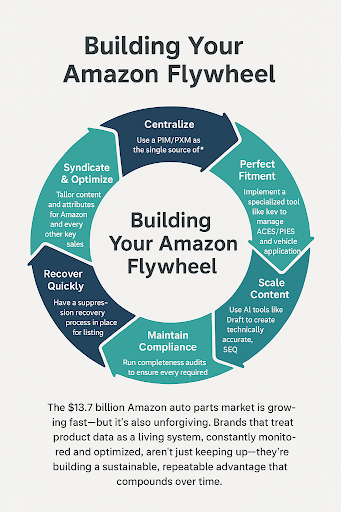
To keep that flywheel spinning, you need the right infrastructure and processes:
- Centralize: Use a PIM/PXM as your single source of truth for all product information.
- Perfect Fitment: Implement a specialized tool like Rev to manage ACES/PIES and vehicle application data with complete accuracy.
- Scale Content: Use AI tools like Draft to create technically accurate, SEO-friendly content at scale.
- Maintain Compliance: Continuously monitor Amazon’s category-specific templates and requirements to prevent suppressions.
- Close Attribute Gaps: Run completeness audits to ensure every required field is filled for each category.
- Automate Syncs: Integrate directly with Amazon to keep product data updated in real time.
- Recover Quickly: Have a suppression recovery process in place for listing or image-related issues.
- Syndicate & Optimize: Tailor your content and attributes for Amazon and every other key sales channel.
The $13.7 billion Amazon auto parts market is growing fast, but it’s also unforgiving. Brands that treat product data as a living system, constantly monitored and optimized, aren’t just keeping up, they’re building a sustainable, repeatable advantage that compounds over time.
Is your product data ready to compete? Let’s connect and build your strategy for winning on Amazon.
Put your parts data to work
We help automotive manufacturers, distributors and retailers manage fitment and product data and publish it to every channel they sell through.
