Organization-Wide Adoption and Integration of Artificial Intelligence
August 26, 2025
This is Part 1 of a 5-part series where we will take a deeper look at the fundamentals of organization-wide AI platform deployment and adoption.
With the rise in adoption of AI in various industry verticals as a natural evolutionary step to improve productivity and reduce inherent inefficiencies, there are key aspects that need to be considered before implementation and deployment of AI platforms to ensure maximum Return-On-Investment (ROI) on the investment.
AI platforms focus on five core elements for delivering value:
- Data Quality
- AI Algorithms
- Data Integration
- AI Workflows
- Change Management
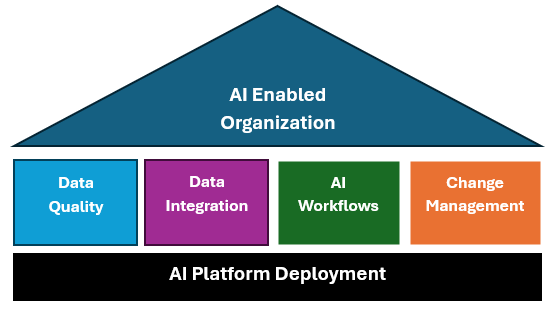
Of the five, only the algorithmic component is proprietary for specific AI service providers. The remaining four elements act as pillars for platform deployment and need to have defined best practices for effective AI implementation across the organization.
Data Quality
The first and arguably most important element in any AI implementation is data quality. Data quality serves as the fuel for any AI implementation, as it drives the algorithmic accuracy and efficiency of any AI platform. This ensures that the algorithms can identify the metadata tagging and structure the responses based on the provided prompts and agentic configuration. Failure to ensure a high-quality data tagging process will result in poor quality output and inefficient usage of the AI platform.
The foundational elements of data quality for effective AI implementation are:
- Clearly identified data sources that drive business value
- Detailed metadata that contains the pertinent data points for the algorithm
- Auxiliary metadata operations such as ranking, sorting, normalization, survivorship and prioritization and finally
- Defined business rules for the data conversion and manipulation
Data Integration
The data output from any AI engine needs to feed into operational and analytical systems in the organization to drive business value and ROI. This needs to be accomplished by an effective middleware solution (commercial, homegrown, or fully managed) that can handle the conversion of the AI output and transmit that at scale to the various systems across the organization. This serves as the second element in an AI implementation, connecting the platform to the existing organization. Failure to implement an effective data integration strategy and a performant platform will result in an isolated AI instance that does not communicate with the rest of the organizational systems.
The primary requirements for any data integration solution are:
- High throughput to ensure performance scaling with growing data volume
- Flexible delivery formats to ensure compatibility with legacy and current systems
- High availability to ensure reliability and minimize downtime
- Ease of deployment to service the organization’s varied systems with minimal complexity
AI Workflows
Any AI output in an organization is based on a series of actions and steps that perform data manipulation to present a desired output. A well-defined data flow with clear stages and defined ownership is required to drive pertinent output as desired by the business teams and should be adaptable in configuration to reflect changing business needs. This is the third element in any organizational AI implementation that is driven by the business teams.
The primary requirements for a well-defined workflow are:
- Clear input and output criteria defined by the business teams
- Defined stages in the workflow for data manipulation
- Identified owners and approvers in each stage of the workflow
- Ease of configuration in various stages of the workflow
Change Management
The fourth and final element for successful deployment of an AI platform is the human element. Deployment of a new system requires successful training of the business and IT teams in usage of the new platform in addition to a formal cutover from legacy processes to the newer and more efficient process, which can be encapsulated as a change management program. Failing to perform effective change management with a new AI platform results in a lack of usage by the business teams and a lack of understanding by the IT teams.
The primary requirements for an effective change management process are:
- Clear buy-in from senior leadership and sponsors
- Defined objectives for the change management program
- Clear communications plan for business and IT teams
- Alignment of the change management plan with the platform implementation plan for parallel execution
In summary, these four pillars serve as the core foundation for the AI-enabled organization. They are necessary pre-requisites for deploying a successful implementation and ensuring adoption of the platform. We will cover each of these aspects in more detail in upcoming blogs to present a detailed picture to leadership teams considering implementing AI platforms to drive business efficiencies.
If your organization is exploring AI platform deployment and would like guidance on building the right foundation, connect with us to start the conversation.
Put AI to work on your product data
We help teams choose useful AI use cases, run a pilot with people in control, and scale what works across their PIM and product content.
