Why Auto Care Standards Alone Won’t Win in Ecommerce
September 30, 2025

Auto Care Standards are like training wheels for product data. They’re essential for balance, but nobody’s going to win the Tour de France with them still on. Meeting Auto Care compliance ensures that your automotive parts data is accurate, structured, and recognizable across the supply chain. That’s important. But when it comes to ecommerce, Auto Care alone won’t carry you across the finish line. Online shoppers don’t care that your catalog data follows industry guidelines. They care if they can find the part, understand it, and feel confident enough to click “Buy Now.”
Let’s break down why Auto Care is necessary but not sufficient, and what you need to layer on top to succeed at winning on the digital shelf.
What Auto Care Standards Do Well
Let’s give credit where it’s due. Auto Care Standards are the backbone of structured automotive product data. They provide:
- Fitment accuracy: Year/Make/Model is captured in a consistent way, enabling you to verify whether a part is compatible with a specific vehicle.
- Standardized part types and attributes: You can call a brake rotor a brake rotor, not 47 different local variations.
- Interchange structure: Ensures parts can be cross-referenced reliably in B2B environments.
- Catalog consistency: Creates a common language that allows manufacturers, distributors, and retailers to trade data without chaos.
Without this foundation, ecommerce would be a Wild West of mismatched terms and failed fitments. But foundations don’t sell products. They just keep the house from collapsing.
Where Auto Care Stops Short
Here’s the uncomfortable truth: Auto Care Standards were never built for digital merchandising. They were designed for supply chain efficiency and B2B catalog alignment. That leaves some big gaps in ecommerce:
- Consumer search language: Shoppers don’t search for “Parking Light Assembly.” They search for “Honda Civic replacement parking light” or maybe “Tail Light for Honda Civic” Auto Care doesn’t bridge that gap.
- Fitment specific merchandising content: Titles, Bullet points, benefit-driven descriptions. Typical Marketing content is generally provided around the base Parent Item.
- SEO considerations: Data may be standardized, but it’s not optimized for how search engines rank and surface products.
- Channel requirements: Amazon, Walmart, eBay, and others all impose their own templates, which go far beyond Auto Care’s baseline.
- Differentiation: If every supplier submits the same compliant data, how does your listing stand out?
Auto Care tells you what the part is. Ecommerce requires you to show why the shopper should care.
The Ecommerce Gap:
Fitment vs. Conversion
Auto Care answers the question, “Does this fit my vehicle?” Ecommerce demands a second, much harder question. “Will this convince me to buy it, and can I find it?”
- Fitment data prevents customer frustration and reduces returns.
- Rich ecommerce data increases conversions and builds brand preference.
One keeps you from losing sales. The other helps you win them.
What Ecommerce Readiness Looks Like
To truly compete online, you need to extend beyond Auto Care compliance and deliver content that’s channel-ready and consumer-friendly:
- Optimized titles and bullets: Structured for both SEO and clarity.
- Expanded attributes: More than “make/model/year.” Think finish, size, material, features, pack count.
- Channel compliance: Amazon wants it one way, Walmart another, your DTC site something else entirely.
- Differentiation hooks: Warranty information, ease-of-installation, benefits framed in everyday language.
This is what closes the sale.
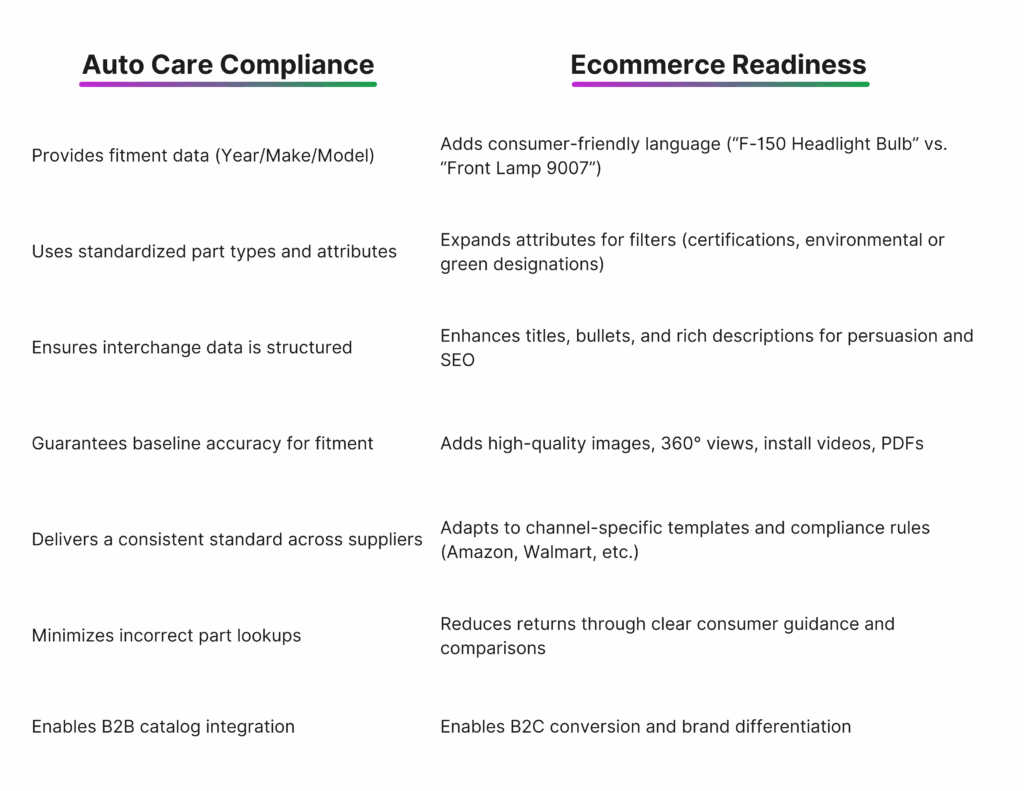
Side-by-Side:
Auto Care vs. Ecommerce Readiness
The Business Impact
Why invest beyond Auto Care? Because in ecommerce, you’re not running time trials—you’re battling competitors lap after lap. Rich, optimized data gives you track position:
- Fewer returns: Clearer content means fewer frustrated buyers.
- Higher conversions: Optimized listings convert browsers into buyers.
- Brand lift: Richer content builds trust and makes your product stand out in a crowded marketplace.
- Channel compliance: Meeting marketplace standards avoids costly delistings or penalties.
Every step beyond Auto Care is like dropping the hammer out of Turn 4—you’re not just in the race, you’re pulling ahead of the pack.
Conclusion
Auto Care standards are non-negotiable. They keep your catalog clean, accurate, and interoperable. But they’re not designed for ecommerce success. If you stop at compliance, you’ve only solved half the equation.
The real winners in digital commerce are the brands and retailers that use Auto Care as a base, then layer on consumer-friendly content, channel-specific formatting, and merchandising detail that drives confidence and conversion.
Compliance gets you in the race. Ecommerce readiness wins it.
Ready to go beyond compliance? Contact us.
Put your parts data to work
We help automotive manufacturers, distributors and retailers manage fitment and product data and publish it to every channel they sell through.
