
This is Part 1 of an 8-part deep dive series to explore how brands win when search becomes a conversation.
Search is becoming a dialogue, and “being in the answer” is the new Page One.
The way people find products has crossed a line. Search engines are no longer handing us pages to click. They are delivering decisions. In this world, visibility is not measured by blue links. It is measured by whether your brand is included in the AI’s synthesized answer to a shopper’s question. If you are not named there, you are effectively invisible at the moment of choice.
From Results to Recommendations
The digital shelf used to be a stack of ranked listings. Now, large models compress that shelf into a short answer and a handful of recommendations. The modern shopper often skips the long compare and scroll. The AI does the comparison and jumps to “what is best for me?”
Two practical implications follow:
- The first page moved inside the chat. If you are absent from the AI’s first answer, the shopper may never see.
- Content must be both machine legible and human useful. The AI needs to parse your attributes and trust your claims before it recommends you.
Classic SEO Caps Out Without GEO
Classic SEO still matters. You still need crawlable pages, technical health, and authority. But SEO alone is optimized for ranking, not for answer inclusion. Generative Engine Optimization, or GEO, extends the playbook so your products are named and recommended in AI generated answers. Think of SEO as earning the click. GEO is earning the answer.
What Changes with GEO:
- Product Data Clarity: Complete and consistent attributes and naming that machines can read reliably
- Benefit Driven, Natural Language Copy: Write to real questions and use cases, for example “smudge proof for left handed writers,” rather than keyword stuffing
- Proof that Models can Site: Refresh reviews and presence on trusted sources that echo the benefits you claim
Two Shelves You Must Win
Shoppers now consult two intertwined ecosystems:
- Open-Web AI: Favors authority, citations, and consistency across credible sources such as media, communities, and review sites
- Retail AI: Favors PDP prevision, structured data, and review language tied to real use cases
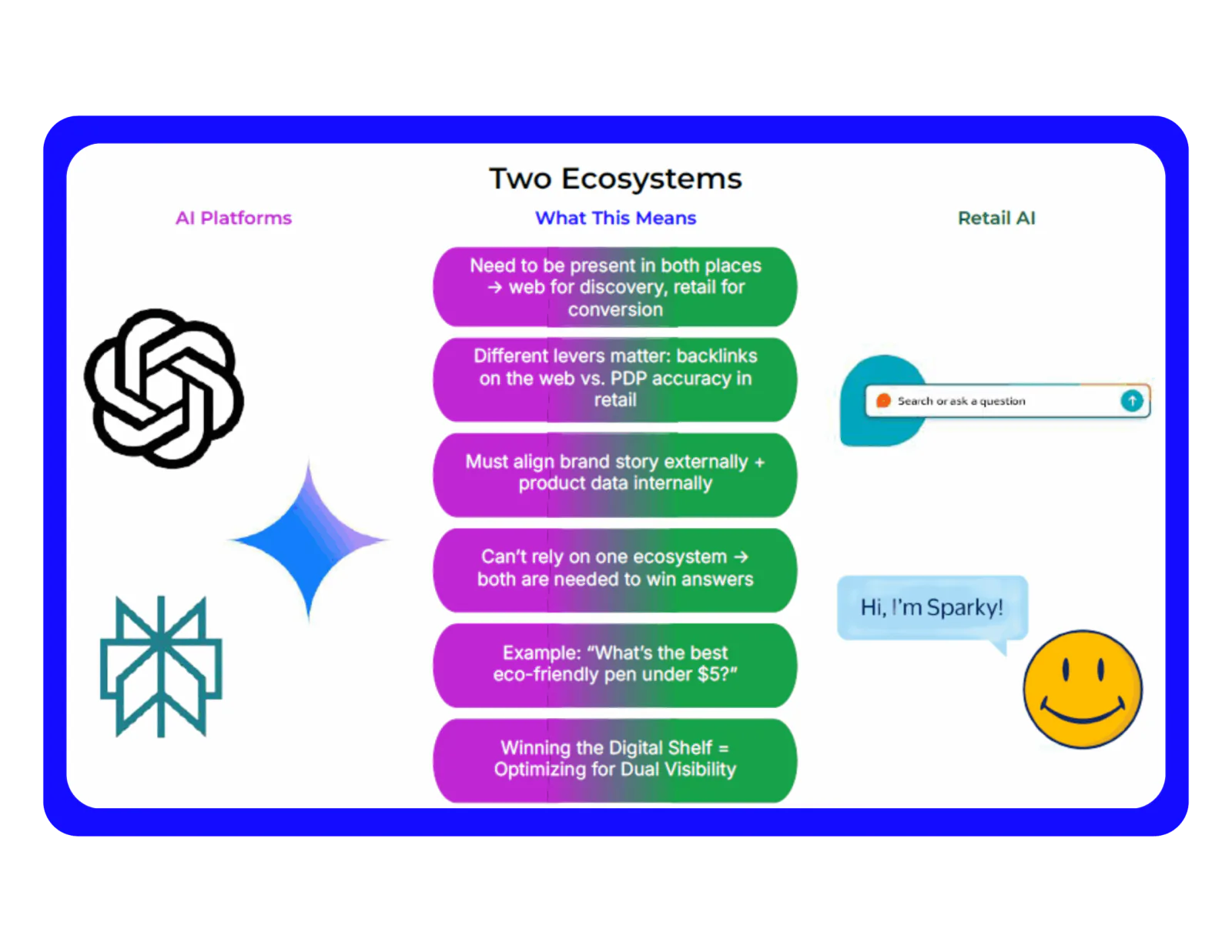
Winning requires dual visibility. Your brand story must show up on the broader web, and your product truth must be explicit inside retailer ecosystems. Different levers, one outcome, inclusion in answers.
What the Retail AIs Reward
- Amazon Rufus compresses choice and surfaces only a few products per question. It prioritizes context rich PDP copy, verified reviews that mirror shopper language, and complete attributes. If your data and reviews do not align to the query, a competitor becomes the default answer.
- Walmart Sparky turns review corpora into summarized recommendations and is moving toward agentic workflows. Frequent, benefit driven reviews and copy mapped to common needs improve inclusion.
This is why review operations are now revenue operations. Models often lift exact phrases from reviews to justify what they recommend. Seed the language you want echoed, ethically, through post purchase prompts and community engagement.
How to Write So Models Can Recommend You
- Be explicit about outcomes. “Smudge proof gel ink for clean signatures, ideal for left hanged writers.” That is GEO ready copy, clear benefit plus specific use case.
- Mirror real questions. Build titles, bullets, and FAQs around the exact phrases your audience uses by season and profile.
- Keep data pristine. Consistent naming, attributes, and feeds across every retailer reduce exclusion risk.
The Operating Loop Behind Answer Inclusion
GEO is not a campaign. It is a loop:
- Identify the seasonal audience and write down their five to seven exact questions.
- State a one line answer, your promise.
- Update your PDPs, including titles, bullets, images, and attributes, to match that intent.
- Prompt reviews to capture proof in the shopper’s own words.
- Measure inclusion, phrase coverage, and conversion, then roll the learning forward.
This loop aligns Sales, Marketing, and E-Commerce around one reality: models recommend what they can parse and prove.
Executive Takeaway: Rebase Your 2026 Growth Plan for GEO
If 2025 was about piloting AI, 2026 must be about operating for answer inclusion. Concretely:
- Make Answer Inclusion Rate and review phrase coverage core KPIs alongside rank and conversion
- Fund three workstreams: Authority on the open web, structure in product data, proof in review language
- Run the copy lifecycle quarterly for your top SKUs and seasons. Report inclusion and margin impacts.
Here’s Bottom line: Classic SEO is still table stakes. Without GEO, it caps out at visibility without recommendation. The brands that learn to be in the answer will own the moments that matter.
Ready to take your search strategy further? Let’s talk about how Sitation can help you build for discoverability and trust.
Keep product content and syndication running
Our managed services team runs PIM operations, taxonomy and syndication alongside your team, from part of one specialist’s week to a dedicated team.
