Data Integration: Connecting the Digital AI Organization
December 16, 2025

Pramit Rajkrishna
Director Solution Consulting
Pramit is the Director of Digital Strategy for Sitation, specializing in product data management and governance, PIM implementations and site, organic and paid search and currently oversees consulting and PIM implementation engagements with Sitation’s enterprise and mid-market customers. Prior to joining Sitation in 2019, Pramit was the Data Strategy and Operations Manager for the Digital division of Arrow Electronics (Fortune 102), based in Denver, CO from 2015 to 2019, driving the reimagining of a new digital experience for the company’s core electronics components distribution business.
Pramit has a Masters in Electrical Engineering from Colorado State University and is certified in Riversand and Salsify PIM platforms, in addition to being certified in Lean-Agile and a Certified Scrum Product Owner (CSPO) by Scrum Alliance.
This is Part 3 of a blog series where we will take a deeper look at the fundamentals of organization-wide AI platform deployment and adoption.
In Part 1 and Part 2, we covered at a high level, two of the five core aspects of AI adoption in the organization for delivering value:
- Data Quality
- AI Algorithms
In this third blog of the five-part blog series, we will cover the key role of data integrations as an integral step for effective AI adoption with the enterprise.
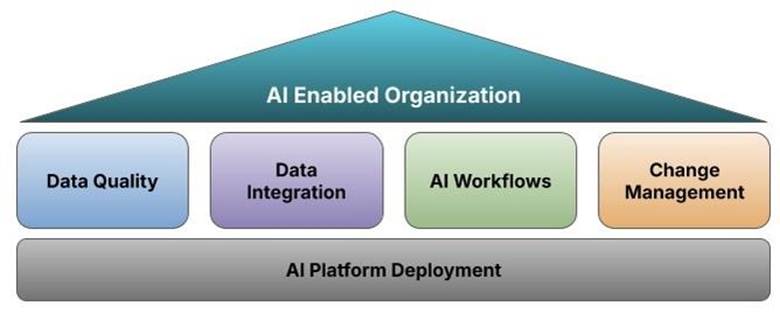
This is a key ingredient for artificial intelligence setup, as the vast majority of current data contained in enterprise systems is relational or analytical data that will need connectivity and translation into the vector database format for the AI models to perform analysis operations.
This is also the most configuration capital intensive effort during setup of the AI connected enterprise, next to the data quality effort, involving significant IT investment and long term CXO vision for the resourcing, tooling and investment roadmap.
Platforms: Connectivity and Integrations
As a first step for connecting AI platforms in the organization to existing/proposed enterprise systems, it is important to establish the correct approach for data aggregation and the transformation rules, prior to intake into the AI models. This is accomplished by the selection of the correct software tooling for the two core functions : connecting the enterprise systems and the data transformation logic.
The software tooling is available in two options:
In-house: Enterprise IT teams can develop in house specialized tools to deliver data for specialized AI use cases to solve for a specific analysis or short term high priority use cases
Commercial: For larger and long term use cases, a commercial solution should be chosen after careful evaluation to address this development need at scale.
| In House Platforms | Commercial Platforms |
| Pros: + Short development lead time + Can meet the data delivery need for a short-term high-priority use case + Can be developed by in-house IT teams with relevant skill sets Cons: – High overhead to develop cutting-edge features for evolving needs – Does not scale with larger or evolving use cases – IT will be a significant cost center to develop functionality, in terms of hosting and development resources – Risk of knowledge silos with specific resources | Pros: + Existing feature set for current use cases + Constantly evolving functionality managed by commercial vendor product teams + Can be configured with an implementation partner and a long-term support structure + Lower IT overhead (hosting and development resources) Cons: – Implementation time might be high for a short-term use case – Licensing and support costs |
Data Transformation and Delivery
As the second step for data movement in the AI connected enterprise, there needs to be consideration to three major areas:
Data Staging: The incoming data stream from enterprise systems need to consolidated in a performant fashion before being aggregated and delivered to the the AI models for analysis – this also includes the performance expectations for the various systems in play
Business Rules: The business logic for converting the data for usage in the AI models and transformation back to a usable form by enterprise systems need to be quantified and configured in the platform
Delivery Formats: The delivery formats (flat files, JSON etc.) need to be established and configured for the data to be usable by the AI models and the connected enterprise systems.
| In House Platforms | Commercial Platforms |
| Pros: + Low complexity business logic can be implemented at short notice + Specialized data interchange formats can be developed as per the use case + Can meet the data delivery need for a short term high priority use case + Can be developed by in-house IT teams with quick turnaround Cons: – Highly complex business rules are harder to troubleshoot – Maintenance and management of the data interchange formats will be an ongoing overhead – Business logic knowledge silo is a risk | Pros: + Business logic can be configured by visual tools or easy to configure code + Performance profiling of business logic is easier with in built tools + Pre-existing export formats in commercial platforms + New platform formats are added and can be added by commercial vendor product teams per request + Can be configured with an implementation partner and a long-term support structure + Lower IT overhead (business logic development) Cons: – Existing formats may not cover a highly specific use case and will need to wait for a platform release |
Middleware Security
As the third step for data orchestration in the AI connected enterprise, there are three major considerations:
Data Hosting: The hosting of the platform and AI models need to be on a compatible setup to be able to communicate with the enterprise systems and orchestrate data.
Data Security: The authentication and permissions layers need to be compatible to enterprise standards (Oauth, MS Entra AD etc) to prevent unauthorized access to sensitive information.
Resource Management: The platform should be able to profile and manage queries into the AI models, to ensure optimal credits usage for models and prevent concurrent expensive queries.
| In House Platforms | Commercial Platforms |
| Pros: + Data is staged in a local environment to the enterprise + Security is managed by the internal teams + Prompt profiling will need to be performed by in-house data engineering teams Cons: – Dedicated admin roles required to oversee access and perform security exercises | Pros: + Data is staged on a secure cloud environment + Access permissions can be managed by in-house IT or integrators as a support function + Performance profiling of prompts can be easily managed with in-built observability tools Cons: – Some very sensitive use cases will require an in-house hosting option; however, commercial options can also pass enterprise-grade security audits. |
This covers the three crucial aspects of data integration for AI models that define the success of the connected AI enterprise. In the next and fourth blog, we will cover AI workflows as a key driver in data orchestration between the AI models and existing enterprise systems.
If you’re building the integration layer for your AI future, let’s talk about how to architect it the right way.
