Iterating With AI: How AI tools can improve PXM through your existing PIM
April 13, 2026
I’ve spent most of my consulting years focused primarily on Implementing and Integration PIM. But what happens after go live? Sure, there’s Hypercare and managed services around support, troubleshooting integrations, and maybe even new feature development for integrations. Often, there’s new catalog onboarding and expansion opportunities for the marketing or product enrichment team, but what about expanding the current products already being enriched today? Given that we are all currently living in a competitive and uncertain environment, how can we audit and improve our core products without slowing down the critical enrichment activities?
Akeneo has invested heavily in AI and has already deployed a number of new features in the PIM to accelerate enrichment, audit and improve the data model, allowing you to quickly bring your status-quo data model up to the latest industry standard. We see this question from legacy clients seeking to maximize their previous investments in PIM. The best place to start is dependent on the client’s priorities, but here are a few new tools we leverage to quickly review a PIM instance and then target for new suggestions.
Akeneo MCP
Sitation has been investing in AI for years, including our now three-year-old generative AI app, launched in the Akeneo App Store at 2023 Unlock. But the future of these tools is far bigger than rich descriptions and chatbots. MCPs allow for coding-like specificity while empowering users to prototype new data model improvements. The Akeneo MCP, which we have been testing and leveraging internally in beta mode, allows for Agents to rapidly review data in the PIM and compare it to websites, pdf’s, powerpoint decks, and any other source that are now supported by AI tools like Claude.
Our favorite use case for this today is to review PIM instances and suggest data model improvements, including but not limited to:
- New Model/Variant structures with family variants
- Leveraging more advanced attribute types like tables attributes or reference entities in place of redundant attributes
- Additional family completeness criteria
I highly recommend giving the tool limited access, including only Read Only permissions for analysis-only work. But what used to take a business consultant days or weeks to review, model, and mock up examples in the PIM is not doable with a quality Prompt and a Claude Cowork account.
Data Architect Agent
The DAA is primarily used by our team as a new data model or prototyping tool, but the ability to safely audit and review the quality of the existing data model in the App is a great way to audit your PIM.

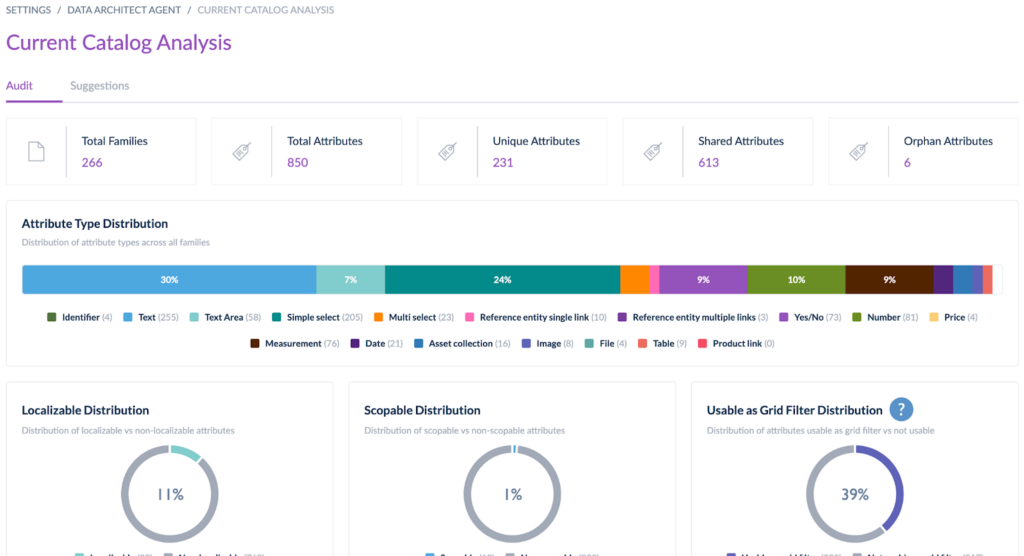
The dashboard here is a powerful and quick tool to see the distribution of attribute types and scopable and localizable attributes. This view of our demo box inspires the following questions for improvement:
1. Can any of the text attributes be converted to a more restrictive attribute type?
2. Should the Image attributes be migrated to assets?
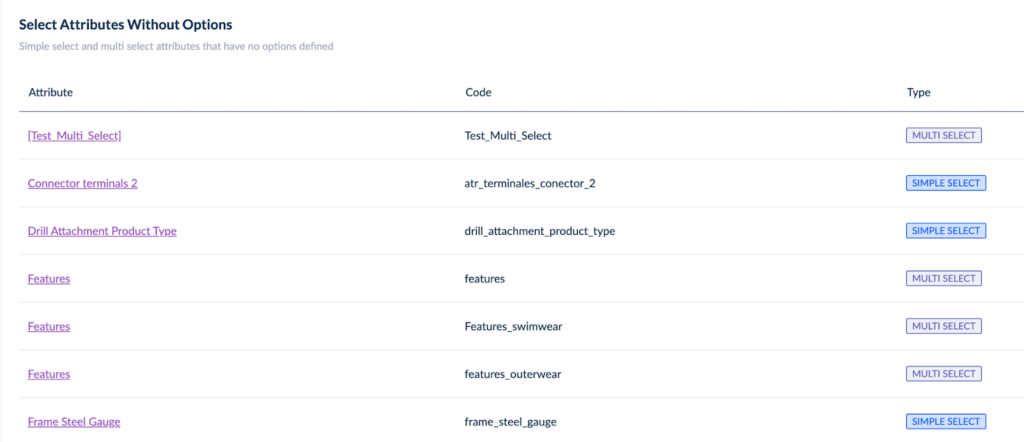
3. Why are there so many ‘select’ attributes without options? Was there an issue with migration or do we simply need to remove those attributes?
In addition to the data review, the DAA allows for AI generated Tailored imports designed to automatically map from an imported file.
Note: Do not delete your instance to see the suggestions!
AI Prompt generation and other Generative AI improvements
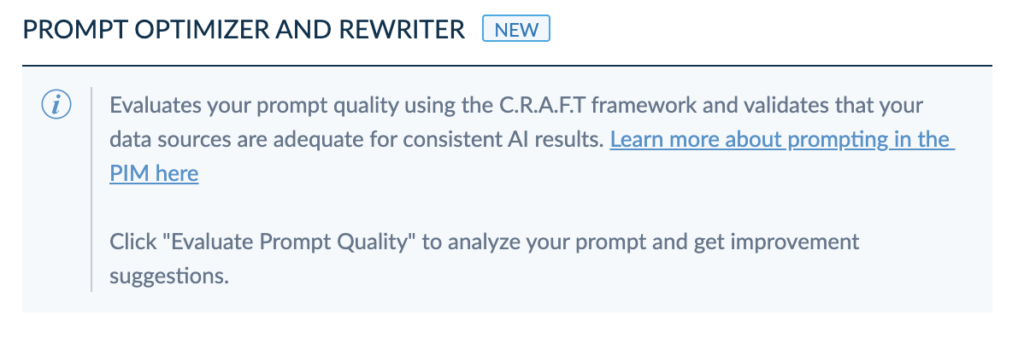
Akeneo’s native AI features have matured considerably, and for clients already live on the platform, this is often the lowest-friction place to start. The built-in prompt configuration allows administrators to tailor AI behavior to reflect brand voice, target audience, and product category nuances. For clients who implemented their PIM before these features existed, the prompt settings were either left at a generic default or never configured at all.
Conclusion
The common thread across all of these tools, Akeneo MCP, the Data Architect Agent, and the native generative AI features, is that they allow you to revisit decisions that were made under different constraints. Your initial PIM implementation was scoped to what you needed at go-live. Your data model, your attribute structure, and your completeness rules all reflect the priorities and limitations of that moment in time.
AI has made it faster and cheaper than ever to revisit those decisions. What previously required a multi-week consulting engagement to audit and roadmap can now be prototyped in days. The barrier to improvement has never been lower, and the pressure to stay competitive has never been higher.
If you’re a legacy Akeneo client asking yourself whether your PIM is still optimized for where your business is heading, the answer is almost certainly that there’s room to improve, and the tools to do it are already available to you.
Ready to find out what’s possible with your existing PIM? Our team helps unlock the value of your Akeneo investment. Get in touch and let’s start the conversation.
Plan your next step with Akeneo
Sitation is a Certified Gold Akeneo partner. We implement Akeneo, connect it to the systems around it and support it after launch.
