Rufus Is the New Aisle, Winning Amazon’s Transaction Shelf in an Answer-First World
March 11, 2026

Alexis Gunn
Consultant, AI Content & Search
Alexis Gunn is an AI Prompt Design and Content Specialist at Sitation, where she leads initiatives at the intersection of artificial intelligence and content strategy. Leveraging a strong foundation in communication and program development, she crafts inclusive, precise content that supports both human understanding and AI optimization. Her expertise includes prompt design and cross-functional enablement, translating business goals into scalable processes.
Alexis earned both her Master of Education and Bachelor of Science in Communication Studies from Grand Valley State University. She currently lives in Detroit, Michigan, with her German Shepard, Stella. In her free time, she enjoys reading, baking sweet treats, and going out on her family’s boat.

This is Part 5 of an 8-part deep-dive series exploring how brands win when search becomes a conversation.
Amazon’s shopping experience is shifting from search-and-scroll to ask-and-decide. Rufus is the clearest signal of that shift. It is not just another feature in the app. It is a new layer of decision-making that compresses the aisle into an answer, plus a short list of recommendations.
If you are not included in that answer, you are not “ranked lower.” You are absent at the moment of choice.
Rufus changes where discovery happens
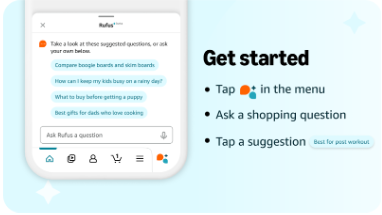
Rufus shows up across the journey:
- Upper funnel: “Help me shop” questions that used to start as keywords and filters
- Mid funnel: narrowing through follow-ups, not pagination
- On the PDP: product-specific questions that determine whether a shopper buys or bounces
This is the transaction shelf evolving in real time. Rufus becomes the interface between intent and inventory.
The leadership trap: looking for a single metric
Most teams ask, “How do we rank in Rufus?” That is the wrong question because Rufus performance is not a single rank or score. What you experience is the combined outcome of four distinct realities:
- Visibility: Do you surface for the prompts that matter?
- Representation: When you surface, does Rufus describe you correctly and persuasively?
- Coverage: On the PDP, can Rufus answer the questions shoppers ask about your specific ASIN?
- Buyability sensitivity: If inventory, pricing, or offer friction exists, Rufus can hesitate to recommend you in high-intent moments.
If you turn these into a scorecard, you get something most brands are missing: a diagnostic system, not a guess.
Rufus does not “read” your listing; it assembles evidence
Rufus pulls from multiple sources of truth, then it summarizes what it can confidently support. That changes the job of your content.
Your PDP is no longer just copy meant to convert. It is evidence meant to be retrieved, grounded, and repeated back to a shopper in natural language. When your product story is fragmented, inconsistent, or overly claimed, Rufus has only two options:
- Respond vaguely
- Surface caveats, sometimes anchored in the most negative signals it can find
Precision is now a revenue lever.
Why intent language is the new shelf space
Shoppers do not think in attributes. They think in context.
They describe a need through five facets:
- A subjective property (sturdy, compact, spacious)
- An event (gift, move, new baby, back-to-school)
- An activity (organize, mount, clean, store)
- A goal or purpose (save time, reduce mess, avoid breakage)
- An audience (students, parents, apartment dwellers, gift buyers)
This is the language of vibes + context, translated into shoppable decisions. If your listing does not explicitly encode this intent language, Rufus has less to retrieve, and less to confidently recommend.
The contrarian truth
You cannot media-buy your way out of missing signals.
Paid can create the moment, but it cannot manufacture clarity. If Rufus cannot parse your product truth and support your promise, it will not explain you well, and it will not push the shopper toward purchase with confidence. Spend follows structure and proof. Not the other way around.
Buyability is now part of the content strategy
Rufus can check real-time details like availability and pricing, and it can help a shopper take action. That means the purchase conditions around your ASIN shape how often you are recommended in high-intent contexts. Even perfect content will underperform if the product is hard to buy right now.
Teams that treat in-stock rate, offer stability, and price integrity as “someone else’s problem” will find themselves invisible in the exact moments they need to win.
What to do next, without boiling the ocean
You do not need a massive replatform to start. You need a focused operating model.
The best early move is to pick a small set of hero ASINs and pressure-test them against the four-part scorecard?
- Are we being surfaced?
- Are we being described correctly?
- Are we answering shopper questions on-PDP?
- Are we consistently purchasable when intent is present?
Then you align the workstreams that actually change outcomes:
- Structure: clean, complete attributes and variation logic
- Language: intent phrasing that mirrors how shoppers ask
- Proof: reviews and Q&A that validate the promise in shopper words
- Retail readiness: fewer offer and inventory surprises
Most brands have pieces of this. Few run it as a system.
Executive Takeaway
In 2026, the winning Amazon strategy is not “optimize the listing.” It is operate an evidence system that makes your products includable, describable, and buyingable inside a Rufus-led journey.
If you want to know where your catalog is strong, where it is brittle, and which fixes will move the needle fast, allow Sitation to build you a Rufus scorecard for your hero ASINs and run a focused diagnostic.
That is the difference between being present on Amazon and being chosen in the answer.
Ready to move beyond AI pilots and drive real organizational adoption? Contact Sitation to build a practical strategy for aligning data, workflows, and change management across your AI initiatives.
