Meet the New Boss, Same as the Old Boss: Product Data, Fitment, and E-commerce for Automotive Success
January 27, 2026

George Dzuricsko
Senior Director, Solution Architecture
George is a technical consultant dedicated to solving problems in the PIM space. He utilizes code, training, and good design to help clients improve their businesses for the past 4 years.
George graduated from Notre Dame and was born and raised in the Chicago Area where he currently resides. He loves the outdoors and can be found mountain biking, climbing, and sitting on patios of local breweries. He’s often joined on client calls by his 2 cats Tucker and Mocha for additional support.
The year is 2026. People no longer ask if you use AI; they ask how you use it and what services are critical to your workflow. Average consumers are turning to AI services instead of (or within) Google Search for researching products to buy, and automotive is included in that. “I asked ChatGPT, and it said …” is the new “Wikipedia says” of starting blogs and articles on any topic. But how does that change ecommerce strategy for the automotive industry?
What’s changing?
Is SEO dying?
Just a few years ago, digital discovery for automotive parts was dominated by traditional web search and marketplace browsing, with search rankings and paid placements heavily influencing traffic and demand. Most shoppers began by typing a query into Google, clicking through results, and navigating websites or category trees to find the right part.
That behavior is already shifting.
Many consumers have already switched to ChatGPT, Anthropic, or Gemini for conversation-based shopping, often leading to lengthy conversations without ever leaving the chat service. Users don’t ask for primary sources, they simply take ChatGPT’s word on something being the best. It’s early, but OpenAI is already pushing to own the entire shopping journey. There’s a lot of complexity here, but that demotes SEO from the gatekeeper of visibility. It’s no longer table stakes for any ecommerce website. Ranking matters less when the shopper never sees a search results page.
This doesn’t mean search optimization disappears. It means it evolves.
GEO (Generative Engine Optimization)
Site Taxonomy is less important (for navigation)
Once, customers finding your website, navigating the category tree and following the breadcrumbs to compare products was how many users found the right product. Internal Site search was critical here as well, as was a manual compare products to decide what to buy. Now, Integrated Agents, smarter AI services (and plugins) can take you directly to the correct part for shopping, and all you have to do is add to cart.
You no longer need to just optimize for clicks. GEO is about getting your products recommended by AI systems that synthesize answers.
Furthermore, marketplaces are encouraging this. Amazon embedded Rufus, their AI shopping assistant, into the experience to ask about the product being viewed or even suggest other products that might be a better fit. Navigating a category tree on a cell phone is much more time consuming than asking the agent to find what you are looking for, regardless of it being a narrative, like “a party outfit” or an explicit question like, “Does this fit my 2016 Subaru Crosstrek?”
What hasn’t changed
Accurate and detailed product data matters
If Chat agents have the ability to create content and are shaping the shopper journey without your customer even seeing your PDP, does it matter if you have robust product data?
Yes. It’s more important now.
AI Agents use that exact data to power the experience! Core Product data, sometimes called Spec attributes and also technical data, is required for agents to evaluate the fit of products that work in chat. If the data is incomplete or incorrect, those agents will be trained by users who ask for alternative options that have what they need.
If manufacturers and brands are further from controlling the story of their products, the only recourse they have within AI is to control the data that powers the story. The IBM Institute for Business Value has noted that agentic commerce depends on trusted, well-governed product data to allow AI systems to act on a brand’s behalf, rather than against it. The quality and structure of your product data increasingly determine how AI understands your catalog.
Compelling stories and accurate data may be rephrased or even restructured by AI, but LLMs always perform better with a good prompt. In a GEO-driven world, the prompt is only as good as the product data behind it.
In addition, while AI companies hide the exact LLM training they do, data available on the open web will power the training and recommendations given directly to customers. If manufacturers and brands are further from controlling the story of their products, the only recourse they have within AI is to control the data that powers the story.
ACES & Fitment powered conversational commerce
“My headlight is broken. Does this fit my car?”
Year/Make/Model/X is the standard that all shoppers looking for a replacement part must know. The dropdown for shop your vehicle is called many things: Amazon and eBay use ‘My garage’, while others save it for shoppers as ‘your vehicle’. This data exists, and must be kept current for all vehicles in the target market.
Incorrectly fitting vehicles costs real dollars every year.
Auto Care Association and MEMA research consistently show that the automotive aftermarket experiences higher return rates than many other industries and that incorrect fitment drives these, collectively costing the industry billions annually. Once shipping, handling, inspection, and restocking are included, returns routinely cost tens of dollars per item, with higher costs for bulky or regulated parts.
For the purposes of this example, I’m going to use Rufus, the Amazon AI agent that currently exists within their search bar and also suggests questions after an initial product search:
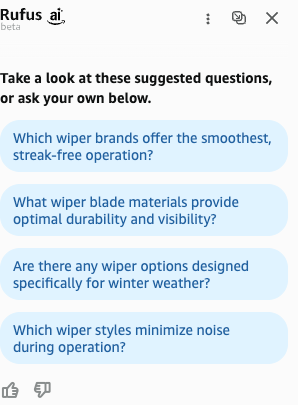
This matches our working assessment of the new world: Customized questions to help identify the right product is a new AI chat feature, but the underlying fitment question that powers that functionality is the same critical fitment data that follows PIES standards. Good fitment data in a drop down menu is essential to good fitment data powering an AI chatbot.

Omnichannel is how shoppers work
Even for power users who are looking to complete their purchase through ChatGPT or another AI interface, shopping rarely happens in a single place.
AI encourages shopping through multiple stores, channels, and experiences. In store shopping amplifies social sites, AI recommends youtube videos for reviews, and those online shoppers will double check Amazon to see if they can get free shipping with Prime.
AI doesn’t always change where people shop, but how quickly they move between channels.
AI speeds up how fast a shopper can comparison shop, but it can also quickly find inaccuracies or conflicting information that damages Brands. Meeting customers where they are is powerful, and that hasn’t changed. What has changed is the definition of “where they are.” AI assistants are now part of the process, but ensuring accurate data and a compelling experience is still table stakes.
Conclusion
AI is changing how shoppers arrive at an answer, but it hasn’t changed what makes that answer correct. Fitment still decides if the part is right. Product data still determines whether it can be trusted. What’s different is that AI now evaluates that information for the shopper, faster and with far less tolerance for inconsistency.
As conversational commerce, generative answers, and embedded shopping agents become part of the buying journey, the brands that win will be the ones whose fitment logic holds up, whose data tells a consistent story, and whose products can be confidently recommended
That’s not new. It’s the same boss the automotive industry has always answered to.
If you’re evaluating how prepared your automotive product data and fitment strategy are for AI-driven commerce, now is the time to take a closer look. Contact us.
