The Interoperability Illusion: Why Leaders Don’t See the Real Enterprise Data Problem
February 18, 2026

Digital transformation is no longer new. Most enterprises have invested heavily in platforms, automation tools, analytics engines, and AI initiatives. On paper, the modern enterprise stack looks powerful.
Yet the results tell a different story.
Despite widespread technology investment, organizations continue to struggle with manual processes, stalled automation, and slow time to value. According to recent enterprise research, 76% of organizations have processes that could be automated but cannot due to data inefficiencies. At the same time, 67% report difficulty connecting new technologies to existing systems.
The problem is not a lack of tools. It is a lack of interoperability.
The Blind Spot in Plain Sight
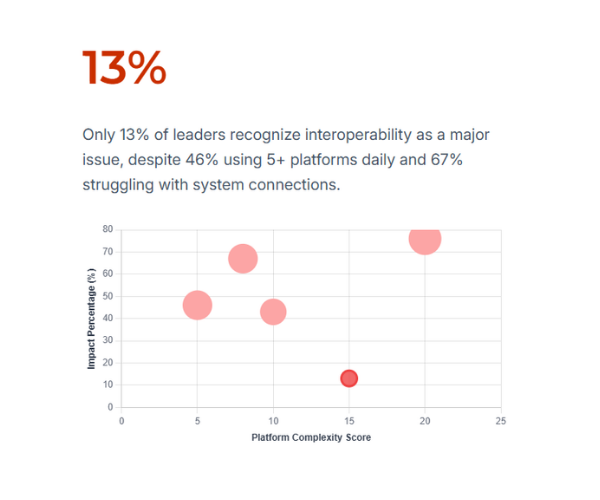
Perhaps the most telling data point is this: only 13% of leaders identify interoperability as a major issue.
That gap should give every executive pause.
Nearly half of organizations use five or more platforms daily. Two-thirds struggle with system connections. Yet very few recognize interoperability as the strategic constraint it has become.
Interoperability is often treated as an IT concern. Something technical. Something tactical. Something to address after platform selection.
In reality, interoperability is a growth issue.
When systems cannot communicate effectively, data cannot flow. When data cannot flow, automation stalls. When automation stalls, manual work increases. When manual work increases, transformation slows.
This is not a technology problem. It is an architectural one.
The Automation Ceiling
AI and automation initiatives dominate executive agendas. But automation does not operate in isolation. It relies on clean, connected, governed data.
When 76% of organizations report they cannot automate processes due to data inefficiencies, the implication is clear: transformation efforts are hitting a structural ceiling.
You cannot automate what you cannot trust.
You cannot scale what you cannot integrate.
You cannot orchestrate what you cannot see end to end.
Too often, enterprises deploy automation tools expecting them to compensate for fragmented data foundations. Instead, the opposite occurs. Each new tool increases complexity. Each new integration creates another dependency. Each workaround becomes another manual step.
Automation fails not because the technology is immature, but because the underlying data ecosystem is.
The Manual Work Trap
The cost of poor interoperability rarely appears in a technology budget. It shows up in human time.
Eighty-six percent of organizations report spending nearly a third of their day on manual data work. In many cases, teams spend over half their time reconciling data across systems, correcting inconsistencies, or duplicating effort.
Manual work becomes normalized. Teams build processes around workarounds. Business units create shadow systems. Spreadsheets multiply.
This is the hidden tax of fragmented architecture.
And it has downstream effects:
- Slower product launches
- Inconsistent customer experiences
- Delayed reporting
- Eroded trust in analytics
- Reduced confidence in AI outputs
The organization that believes it has a productivity issue often has a data orchestration issue.
Technology Is Not the Barrier. Integration Is.
Interestingly, 59% of organizations cite technology obstacles as growth barriers, compared to 21% who cite economic disruption.
This signals something important.
Leaders recognize that something within their technology environment is holding them back. But they may be misdiagnosing the source.
The obstacle is not the commerce platform. Not the PIM. Not the ERP. Not the analytics engine.
The obstacle is how they work together.
Without a unified data strategy, each new platform compounds complexity. Without governance, each integration increases risk. Without interoperability, transformation initiatives become isolated successes rather than systemic improvements.
The enterprises that move forward are not those that purchase the most tools. They are the ones that design systems to operate as an ecosystem.
What Must Change
Interoperability cannot remain an afterthought. It must become a design principle.
Enterprise leaders should focus on:
- Establishing a clear data ownership and governance framework
- Designing integration architecture before selecting additional platforms
- Treating master data as strategic infrastructure, not operational plumbing
- Measuring automation readiness based on data maturity, not tool availability
When systems are architected to communicate seamlessly, automation becomes sustainable. AI becomes reliable. Teams spend less time reconciling and more time innovating.
Interoperability is not a backend technical concern. It is the foundation of scalable growth.
Unlocking the Growth Potential
The modern enterprise does not lack technology. It lacks alignment.
The organizations that unlock meaningful transformation will be those that close the interoperability gap, reduce manual data work, and create an integrated data foundation that supports automation and AI at scale.
The question is no longer whether to invest in digital transformation.
The question is whether your systems are built to work together.
In partnership with Stibo Systems, we visualized these findings to highlight a critical truth: interoperability is not a technical inconvenience. It is a growth constraint. Explore the full research and insights in our infographic, The State of Enterprise Data Management, and see how your organization compares.
