

THE OPPORTUNITY
A new competitive battleground, and most brands aren’t ready
Out-of-stock moments are becoming recommendation moments.
When a shopper discovers that their preferred product is unavailable, they do not always leave the site or try a different retailer. Increasingly, they ask AI what to buy instead. And when they do, AI makes a recommendation.
The question is whether it recommends your product.
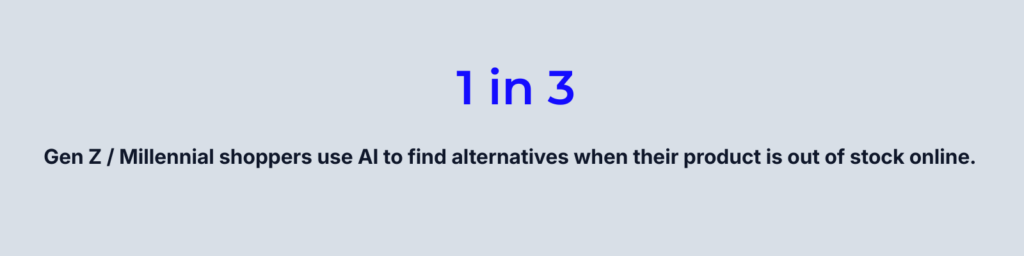
This shift changes what it means to compete online. Brands are no longer just fighting for visibility on the search results page. They are fighting to become the product AI reasons toward when a competitor goes dark.
THE FRAMEWORK
Three signals that shape AI recommendations
When a shopper asks AI to recommend an alternative to an out-of-stock product, the model is not simply running a keyword match. It is using available signals to determine which product best fits the shopper’s needs.
That reasoning draws from three layers:
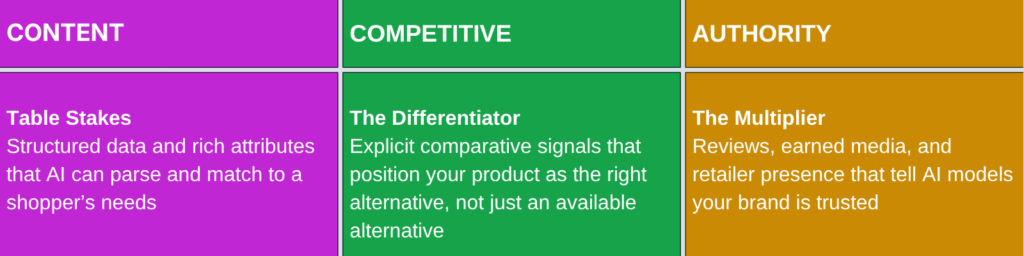
Structured content is the entry fee, but most brands stop there. The competitive and authority layers are where the recommendation is actually won or lost.
BEYOND THE FRAMEWORK
What brands need to win the replacement moment
Structured data and rich attributes are necessary, but they are no longer enough. To get recommended when a competitor goes out of stock, brands need to give AI the evidence it needs to understand, compare, and trust their products.
1. Build explicit “compare to” content
AI models reason about alternatives by comparing attributes. Product pages should include copy that names category benchmarks and articulates parity or superiority, including ingredient match, size or format equivalency, use-case overlap, and shopper need state.
Do not make AI infer the connection. Say it directly.
2. Own the “best alternative to X” search surface
Brands should create content that directly targets comparison queries, including blog posts, A+ content, and comparison landing pages. AI models are trained on and retrieve from open-web content, so visibility for “best alternative to [competitor]” terms still matters.
If your brand does not create this content, a competitor, retailer, publisher, or third-party affiliate will.
3. Drive review velocity and recency
AI weighs social proof when recommending alternatives. A product with recent, detailed reviews has a stronger recommendation signal than a structurally similar product with older or thinner review content.
The language inside reviews also matters. Reviews that say things like “great substitute for,” “just as good as,” or “switched from X to this” create comparison-relevant signals that help AI understand why one product can replace another.
4. Maintain consistent in-stock signals across retailers
AI models that pull live or semi-live inventory data may deprioritize products that are frequently unavailable themselves. Broad retail distribution and consistent availability are becoming content signals, not just supply chain metrics.
If your brand wants to be the alternative shoppers switch to, it has to be available when the switch happens.
5. Feed the third-party knowledge layer
AI models do not only read brand PDPs. They are trained on and retrieve from editorial roundups, Reddit threads, affiliate comparison sites, retailer content, and “best X for Y” articles.
Earning mentions in these sources creates ambient authority that structured product data alone cannot replicate. A modern PR and earned media strategy should account for how these sources shape AI’s understanding of a category.
6. Audit your brand entity representation
AI models build an entity-level understanding of your brand, including name variants, category associations, product attributes, and retailer presence.
Inconsistent naming, miscategorized products, thin brand descriptions, or conflicting product information across retailers and data feeds can weaken that entity definition. A content audit through this lens is worth doing now, before competitors build a stronger AI-readable footprint.
THE DETAIL MOST BRANDS MISS
Your own availability matters too
There is a compounding dynamic worth calling out directly: the brands most likely to win out-of-stock replacement recommendations are also the brands least likely to go out of stock themselves.
Availability signals reliability. Reliability shapes recommendation quality. And recommendation quality is increasingly part of how AI decides which brands to surface.
That means getting recommended as an alternative and staying available once recommended are not separate workstreams. Distribution investment and content investment need to move together.
WHERE BRANDS SHOULD START
Recommended next steps
The right starting point depends on where a brand’s content, authority, and distribution gaps are today. In general, brands should prioritize five areas.
- Content Audit Assess attribute completeness and consistency across retailer feeds and PDPs. Identify gaps in comparative language, use-case copy, and product detail that could prevent AI from understanding when your product is a relevant alternative.
- Competitive Content Build-Out Develop comparison-focused content across PDPs, A+ content, landing pages, and editorial surfaces. Prioritize the out-of-stock replacement scenarios most likely to affect your category and your top competitors.
- Review Strategy Build a program to increase review velocity and recency, with a focus on generating detailed, comparison-relevant language that helps AI understand why shoppers choose your product as a substitute.
- Distribution Review Map availability across key retailers and identify coverage gaps that could undermine AI recommendation quality. A product cannot win the replacement moment if it is not available when shoppers are ready to switch.
- Third-Party Authority Identify editorial, affiliate, community, and retailer sources where competitors are already mentioned as category benchmarks. Then build a strategy to earn presence in those same contexts.
For brands, the next shelf battle will not only happen on retailer search pages. It will happen inside AI-generated recommendations, especially when shoppers are actively looking for a substitute.
The question is not just whether your product is available. It is whether AI understands why your product is the right alternative when another brand is not.
If your team is evaluating how your brand shows up across open-web AI, retail AI, and AI-driven shopping journeys, now is the time to understand where you are visible, where competitors are gaining ground, and what it will take to win the replacement moment.
Reach out to Sitation to pressure-test your AI shelf strategy and identify the opportunities your brand may be missing.
Keep product content and syndication running
Our managed services team runs PIM operations, taxonomy and syndication alongside your team, from part of one specialist’s week to a dedicated team.
