The Art of PIM Consolidation
July 23, 2025

Steve Engelbrecht
CEO & Founder
Steve founded Sitation in 2001 and has enjoyed a long and successful career as an e-commerce technology executive and entrepreneur. He is passionate about building relationships with clients and helping them to solve problems and achieve growth with technology solutions.
Steve earned his bachelor’s degree in computer science from Cornell University and his MBA at the Wharton School at the University of Pennsylvania. Steve was born and raised in New York, and today lives with his family in Cary, North Carolina.
Steve frequently attends and presents at industry events, and is active on LinkedIn. Please follow and connect!
This is Part 2 of our 4-part series on Global PIM Strategy. In Part 1, we explored the fundamental paradox between unity and diversity in PIM. Now we examine when and how to achieve unity through consolidation.
The Multi-PIM Reality
We see it all the time. Many companies have multiple PIM systems.
The path to PIM proliferation is surprisingly common:
- Acquisition Growth: Company A buys Company B, inheriting their PIM(s)
- Regional Independence: European office implements Akeneo while US uses Salsify. Another team has their own homegrown solution. Mexican team likes the spreadsheets and doesn’t want to change.
- Departmental Silos: Marketing adopts one system, e-commerce another
- Brand Separation: Each brand maintains its own PIM “for flexibility”
- Legacy Accumulation: Old systems never decommissioned, new ones added
Sound familiar?
True story – one Fortune 500 retailer we worked with discovered they were running 15 different PIM instances from 5 different providers across their organization, spending more than $4 million annually just on licenses, not to mention the inefficiencies of managing siloed implementations in each of those markets and locales.
In fact we used to joke with them – “What PIM do you have?” The answer? “Yes.”
This client grew quickly through acquisition and knew they were creating technical debt. They wanted to fix it themselves, and subsequently established an internal task force which spent 2 years trying to unwind the mess and figure out a plan to go forward (spending another 7 figures in the process). And even then, they couldn’t get it done. Yikes!
There are cases where multiple PIMs makes sense (see Part 3), but often the right choice is to consolidate. In this blog, we’ll investigate how Sitation helps global organizations to do just that. It’s a hard problem, and one which requires a well-planned and well-executed approach.
It should be noted, of course, that this isn’t unique to PIM – many important systems can end up in similar scenarios. But PIM, for some reason, often seems to live in a liminal space where inefficiency is tolerated longer than other critical IT systems (and related cost centers).
Let’s investigate further:
The Hidden Costs of PIM Fragmentation
Multiple PIMs can drain budgets:
- License multiplication: $250K-500K per system annually, on average
- Integration complexity: Custom connections between systems
- Maintenance overhead: Separate teams, vendors, upgrades
- Training redundancy: Staff learning multiple platforms, more team members, consultants, temps means higher TCO
- Context switching & multiple entries: Same data into many systems = time and energy wasted
Typical annual cost: $2-5 million in hard costs for 3-5 systems is not at all uncommon
Fragmentation creates daily friction:
- Data inconsistency: Same product, different information – extremely easy to get “out of sync”
- Process duplication: Parallel workflows for identical tasks
- Update delays: Changes cascade slowly through systems
- Quality degradation: Each handoff introduces errors
Multiple PIMs can be blockers:
- Unified customer experience: Inconsistent across touchpoints
- Global product launches: Coordination nightmares
- Analytics accuracy: Fragmented data tells lies
- Innovation velocity: Resources tied up in maintenance
- Strategic investment: Identifying points for creating leverage gets harder and harder
The Consolidation Framework
At Sitation, we’ve developed a proven framework for PIM consolidation, breaking it into logical steps with clear objectives and deliverables defined.
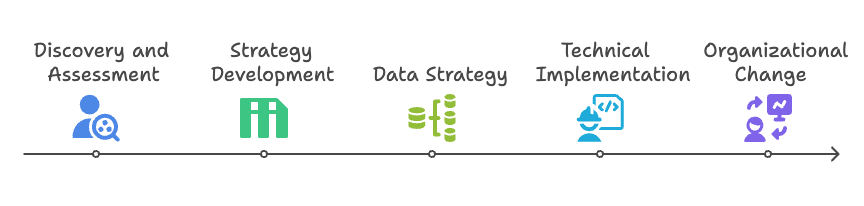
Phase 1: Discovery and Assessment
System Inventory
- Document every PIM instance
- Map user communities
- Identify data domains
- Calculate total costs
Data Analysis
- Product overlap assessment
- Attribute mapping
- Quality benchmarking
- Volume analysis
Process Documentation
- Workflow mapping per system
- Integration touchpoints
- Business rules capture
- Performance metrics
Needs Assessment & Requirements Gathering
Strategic goals for content programs are critical – A deep investigation of “as is” vs “to be” states. Where are we, and where are we going?
- Must haves and nice to haves
- Key data and process flows
- Ask why, over and over, to illuminate what’s actually important to support business objectives
Stakeholder Alignment
- Executive sponsorship (CRITICAL!)
- Department buy-in
- Change readiness assessment
- Success criteria definition
- Establish a realistic timeline and budget
Phase 2: Strategy Development
With the decision made to consolidate, there are important considerations to take into account.
Architecture Decision
Option 1: Single Global PIM
- Pros: Maximum efficiency, single source of truth
- Cons: Complex migration, potential functionality gaps
- Best for: Unified business models
- Centralize PIM ops
Option 2: Hub and Spoke
- Pros: Balances central control with local needs
- Cons: Continued complexity, integration requirements
- Best for: Diverse business units
- Centralize most PIM ops while allowing local customizations and modifications
Option 3: Federated Model
- Pros: Preserves regional autonomy
- Cons: Ongoing coordination challenges
- Best for: Highly distributed organizations
- Centralize PIM strategy, but PIM is maintained regionally
Platform Selection Criteria
- Scalability for combined volume
- Features & requirement mapping
- Global/local capabilities
- Integration flexibility
- Total cost of migration
- Total cost of ownership
- Projected 3-5 year ROI
Phase 3: Data Strategy
The Master Data Challenge
Consolidating PIMs requires solving:
- Identity Resolution: Which product record is truth?
- Attribute Harmonization: Standardizing different schemas
- Hierarchy Reconciliation: Merging category structures
- Relationship Mapping: Preserving cross-references
Data Migration Approach
- Big Bang: All at once
- Pros: Clean cut-over
- Cons: High risk, complex coordination
- Phased by System: One PIM at a time
- Pros: Manageable chunks
- Cons: Extended timeline
- Phased by Domain: Products/categories/regions
- Pros: Business continuity
- Cons: Complex coexistence
All three are possible – and we have done them all. But we usually recommend option 3, which creates opportunities for a phased go-live.
Phase 4: Technical Implementation
Integration Architecture
- API-based data movement
- Real-time synchronization during transition
- Fallback mechanisms
- Performance optimization
Data Quality Framework
- Cleansing before migration
- Validation during transfer
- Enrichment opportunities
- Ongoing governance
System Coexistence
- Temporary bridges between systems
- Phased decommissioning
- User access management
- Business continuity
Phase 5: Organizational Change (Throughout)
Change Management Excellence
- Clear communication cadence
- Training programs by role
- Champion networks
- Resistance management
Process Redesign
- Standardized workflows
- Best practice adoption
- Efficiency optimization
- Governance model
Consolidation Success
These are extremely complex projects, often more complex than an initial standup of a major system like a PIM. But as with other digital transformation efforts, when done well, the results justify the investment.
Important lessons we have learned along the way:
- Perfect unity isn’t always necessary
- Balance global/local needs
- Focus on business outcomes
- Celebrate incremental progress
- As Winston Churchill might have said about data migrations: ‘If you’re going through hell, keep going.’
Common Consolidation Pitfalls
Pitfall 1: Underestimating Complexity
Reality: It’s always harder than it looks
Solution: Realistic budgeting and timelines. Digital transformation is expensive (but worth it).
Pitfall 2: Technology-First Thinking
Reality: Success is ~70% people, ~30% technology
Solution: Invest heavily in change management. Earn the buy-in of the team. Listen to the people who will be doing the work – the “wisdom of the crowd” is too often overlooked.
Pitfall 3: Perfectionism Paralysis
Reality: Waiting for perfect conditions means never starting
Solution: Accept intelligent compromises. Keep moving.
Pitfall 4: Big Bang Bias
Reality: All-at-once rarely works
Solution: Embrace phased approaches, focus on key markets, key categories. Think about the Pareto Principle – put time, energy, and investment into what matters the most.
Pitfall 5: Stakeholder Fatigue
Reality: Long projects lose momentum
Solution: Deliver value incrementally and keep your eye on the prize. Get to revenue and celebrate wins when you see the light at the end of the tunnel!
The Path Forward
In summary, PIM consolidation is a demanding but highly rewarding journey. Achieving success hinges on strong executive sponsorship, setting realistic expectations, and maintaining a pragmatic mindset—recognizing that incremental progress often delivers the greatest value. Above all, prioritizing people and organizational change over technology ensures lasting transformation. By focusing on tangible benefits and adapting along the way, organizations can unlock new levels of efficiency and agility in their commerce operations.
The organizations that master PIM consolidation gain more than efficiency—they gain the agility to compete in modern commerce.
Ready to consolidate your PIM landscape? Let’s discuss your unique situation and build a pragmatic path to a unified PIM solution. Contact Sitation today.
Please continue to Part 3: Sometimes Having Multiple PIMs Makes Sense
