At this year’s GS1 Connect 2026 in Las Vegas, Sitation surveyed product data and supply chain professionals to take the temperature on master data management. Taking a look at the challenges, the team dynamics, the tools, and the state of AI adoption, the results paint a clear picture: the industry is navigating real complexity, and most teams are doing it largely on their own.
Let’s examine what we learned.
Data Silos and Quality Gaps Dominate the Conversation
When asked about their biggest master data challenges, respondents pointed overwhelmingly to two issues: data siloed across systems with limited integration, and poor data quality and gaps across sources. These weren’t rare complaints but nearly-universal.
Technology gaps, changing requirements, and unclear governance each surfaced as well, but at much lower frequency. The message is clear: silos and quality are the persistent, structural problems that most teams are contending with every day.
The Question: What are the biggest challenges your team faces with master data quality today? (multi-select question)
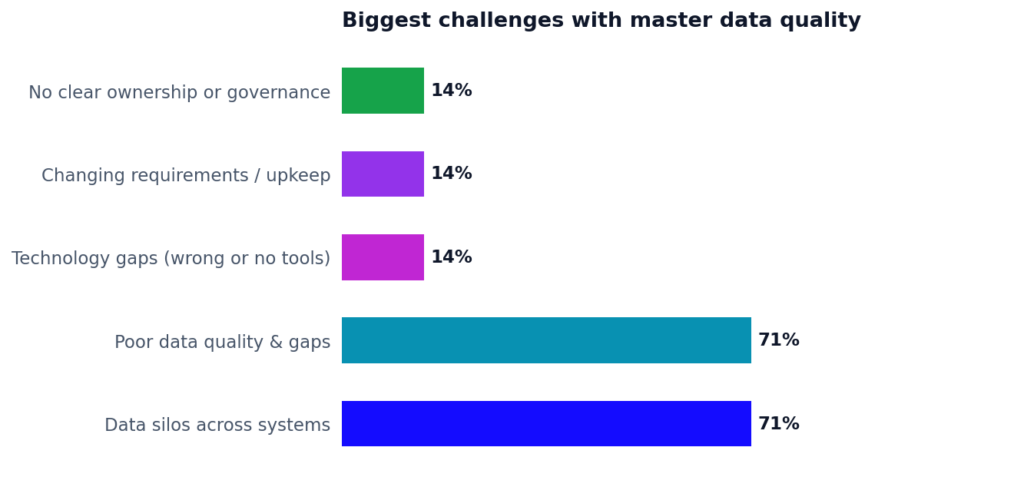
Data silos and quality gaps aren’t new problems. Their persistence signals they’re structural and not easy wins.
Team Alignment Around Product Data Remains a Work in Progress
The majority of respondents described their team dynamics as complicated or siloed, marked by handoffs, confusion, or teams working in isolation. Few described their organization as a well-oiled machine with clear roles and good communication.
For most, cross-functional alignment around product data is still evolving. Handoffs happen, ownership is unclear, and coordination takes effort. That’s not a criticism. It’s the reality of how complex product data has become across modern organizations.
The Question: How would you best describe the working dynamic between the teams involved in product data at your organization?
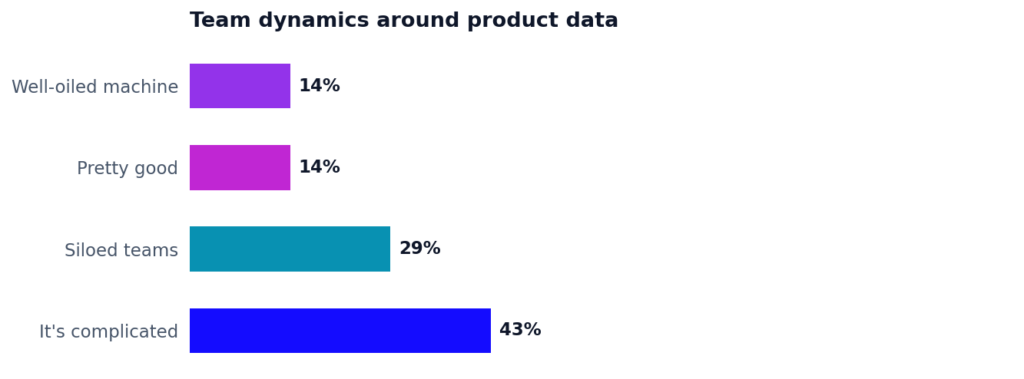
Cross-functional alignment on product data is hard. Most teams are somewhere between “pretty good” and “it’s complicated”
Most Teams are Handling Syndication In-house
Nearly three-quarters of respondents manage their syndication primarily or fully in-house, with only occasional outside support for specific projects. On the surface, that sounds like control. In practice, this in-house lean, combined with the data quality and team dynamics challenges above, puts significant pressure on internal resources. It often means stretched internal teams absorbing complexity that compounds over time. Teams are owning more of the work with tools and processes that still require heavy manual effort.
Operating a true hybrid model, with internal teams owning strategy and governance while a partner handles execution, represents a different approach. It’s one that preserves accountability without concentrating all the operational burden on people who are already managing siloed systems and manual workflows.
The Question: How would you best characterize your use of agencies and partners in managing syndication?
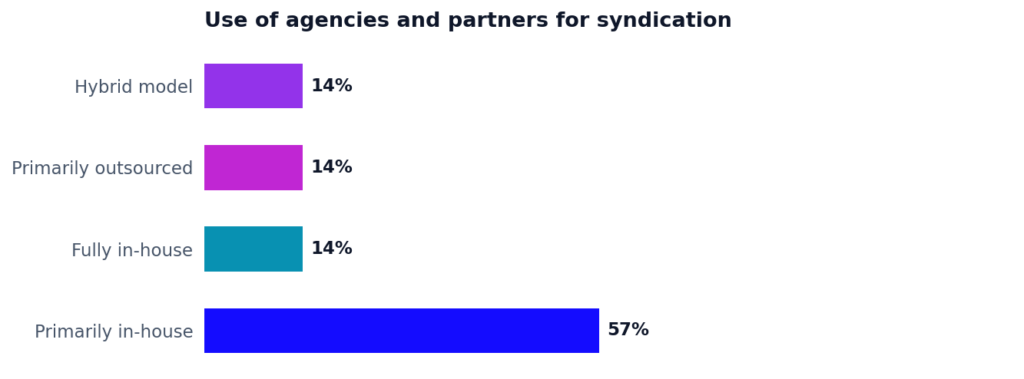
Most teams own their syndication end-to-end. Without the right tooling and processes, it becomes a compounding risk and a heavy lift
No One Has a Fully Integrated Tech Stack
Every single respondent still has manual work somewhere in their digital stack. About half described their technology as partially integrated, with significant manual work still required. The other half described a mostly integrated environment with some manual handoffs remaining. The “fully integrated” option went unchecked.
This reflects a broader industry truth: even organizations that have invested in PIM, MDM, or syndication platforms often find themselves bridging gaps with spreadsheets, email, and manual exports. Integration is a journey, not a destination.
The Question: How well-integrated is your digital technology stack today?
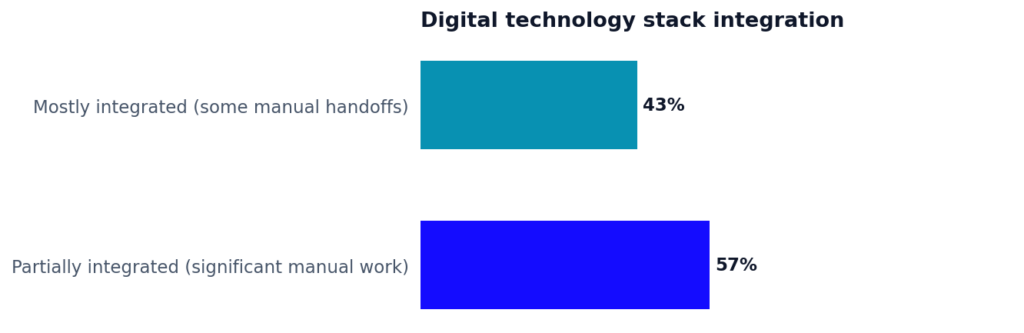
Manual work is still part of everyone’s workflow. The question is, how much?
AI Adoption is Early, Uneven, and Mostly SaaS-native
Nearly half of respondents aren’t using AI in their product data workflows at all. Among those who are, most rely on AI features built into their existing SaaS platforms. Few have deployed a dedicated IT-managed enterprise AI layer, and one uses a hybrid approach combining both.
This distribution makes sense. Implementing standalone AI infrastructure requires resources, expertise, and organizational readiness that most teams are still building toward. For now, SaaS-embedded AI is where most organizations are getting their first taste.
The Question: How would you best describe your organization’s current use of AI in your product data and syndication workflows?
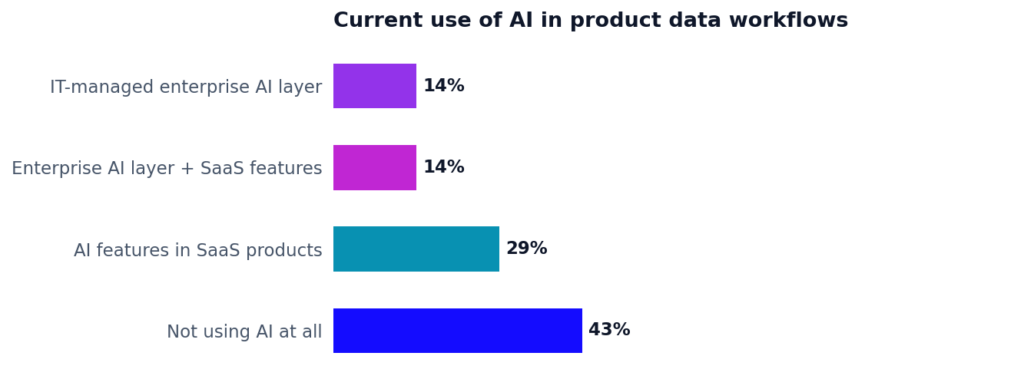
AI is on everyone’s radar, but most teams are early-stage. SaaS-native features are the on-ramp, but dedicated AI strategy comes next.
The Bigger Picture
Taken together, these responses describe an industry at an inflection point. The fundamentals, like clean data, aligned teams, and integrated technology, remain unsolved for most organizations. And AI as the emerging opportunity is still largely untapped.
These aren’t problems unique to any one company. They’re industry-wide, and they’re driving real decisions about tooling, resourcing, and strategy. The teams that solve the structural problems first will be the ones best positioned to put AI to meaningful use.
Sitation works with product data teams every day on exactly these challenges. If any of this sounds familiar, let’s talk.
Plan your PIM, MDM or DAM project
From platform selection to launch and ongoing support, Sitation has helped more than 400 retailers, distributors, brands and manufacturers put their product data to work.
