The Salsify API lets partners, developers and customers extend Salsify into their own applications: read, create, update and delete products, digital assets, records and other Salsify resources, run bulk imports and exports, and receive webhook notifications when products, assets or imports change. It is a RESTful API authenticated with a user API key or OAuth 2.0, limited to 10,000 requests per hour per Salsify organization, and documented on the Salsify Developer Hub.
Originally published May 2022. Updated September 2026 with authentication, rate-limit and webhook details from the Salsify Developer Hub.
What is the Salsify API?
Salsify provides a simple, RESTful API for interacting with Salsify resources. The API consists of a set of resources representing Salsify resources (products, channels, assets, etc.) and operations on those resources, such as reading, writing and deleting of individual entities (CRUD operations), as well as bulk operations.
Virtually every aspect of the Salsify data model can be accessed through the API, including products, digital assets, channels, and more. Salsify webhooks are another powerful resource, allowing you to integrate real-time notifications into your app based on changes made inside your instance. Salsify also offers GraphQL APIs for operating on accounts and organizations; Salsify lists these as early access and liable to change.
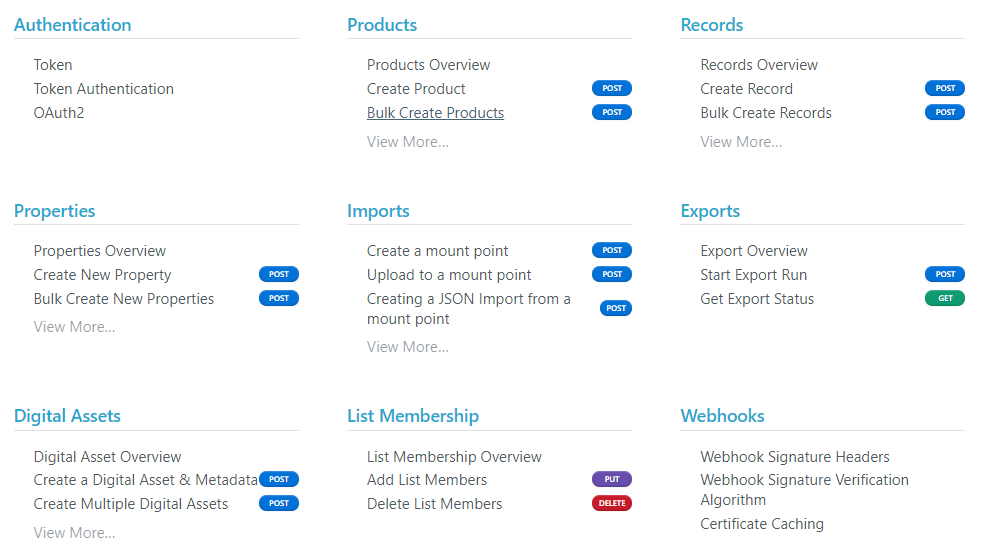
The Salsify Developer Hub provides excellent Salsify API documentation to help users build their own applications which integrate with Salsify.
What you can build with the Salsify API
- System integrations: move product data between Salsify and your ERP, eCommerce platform or other systems, using bulk imports and exports for large volumes.
- Event-driven updates: use product change, digital asset and import webhooks to act as soon as something changes in Salsify, instead of polling for changes.
- Supplier and vendor onboarding: collect product content from suppliers in a portal and load it into Salsify.
- Custom tools and automation: build apps for your own teams that read and update product content in Salsify.
Authentication
Every Salsify user has an API key, sent in the Authorization header as a bearer token. A key carries all the permissions of the user it belongs to, so plan which user an integration runs as. If you are building an integration that many Salsify users will connect, Salsify acts as an OAuth 2.0 provider, so users can grant access without sharing their credentials or API keys. Browser sessions are for interactive use only.
Salsify API rate limits
Salsify allows each organization 10,000 API requests per hour, whichever user makes them. Every response includes x-ratelimit-limit, x-ratelimit-remaining and x-ratelimit-reset headers. Over the limit, requests receive 429 Too Many Requests until the counter resets at the top of the hour. Interactive use of the Salsify app is limited separately and doesn’t count toward the API limit.
In practice, this means an integration should use bulk imports and exports for large jobs, react to webhooks rather than repeatedly polling, and watch the rate-limit headers. Webhooks also need care: Salsify retries a failed delivery 15 times over 48 hours, and may combine several quick changes to the same product into one notification.
How can Sitation help?
As a Salsify Platinum partner, Sitation makes extensive use of the APIs in many Salsify projects and add-ons, including our Plezio Portal and Plezio Fuse. As an expert in building applications on the Salsify API, we encourage you to reach out to us if you need help. We can assist you with designing and executing your vision for how to leverage the Salsify API for your particular needs. Salsify API limits apply in all applications, so it’s important to know what you’re doing to make sure your application will scale. Our PIM implementation and integration team designs for those limits from the start.
Frequently asked questions
Is the Salsify API REST or GraphQL?
Both exist. The main Salsify API for products, digital assets, imports and exports is RESTful. Salsify also offers GraphQL APIs for account and organization operations, which it describes as early access and liable to change.
What is the Salsify API rate limit?
10,000 requests per hour per Salsify organization for API key and OAuth 2.0 requests, regardless of which user makes them. Each response reports your remaining requests and the seconds until the limit resets, and requests over the limit return HTTP 429.
How do I authenticate with the Salsify API?
Send your user’s API key as a bearer token in the Authorization header. For integrations that other Salsify users will connect to their own accounts, use OAuth 2.0.
Does Salsify support webhooks?
Yes. Salsify can send webhooks when products are added, changed or removed from a defined set, when digital assets change and when imports run.
Where is the Salsify API documentation?
On the Salsify Developer Hub, which covers authentication, rate limiting, imports, exports, webhooks and the GraphQL schema.
Get more from your Salsify program
Sitation was Salsify’s first Platinum Solution Partner and has completed more than 200 Salsify implementations. Tell us what is slowing your team down and we will suggest where to start.
