
Salsify PIM is the product information management software at the center of Salsify’s product experience management (PXM) platform. It gives brands and manufacturers one cloud system of record for product data, with workflows to enrich that data and built-in syndication to publish it to retailers, marketplaces and their own sites.
This guide explains what Salsify PIM does, who it fits, what drives its price and how an implementation works. It also covers what Sitation sees after the contract is signed, from more than 200 Salsify implementations.


- FirstSalsify Platinum Solution Partner
- 200+Salsify implementations
- 60+active Salsify certifications
What is Salsify PIM?
A PIM (product information management) system is the place where a company keeps the approved version of its product data: names, descriptions, specifications, images and the attributes each channel asks for. Salsify describes its PIM as “a central system of record for all product data” (Salsify PIM).
Salsify sells PIM as part of a wider platform it calls product experience management, or PXM. The PIM holds the record. Around it, the platform adds syndication, enhanced content for product pages, a GDSN data pool, digital shelf analytics, catalog sites and AI features (Salsify PXM). Retailers use a related product, Supplier Experience Management, to collect product content from their suppliers.
In practice, Salsify PIM sits between the systems where product data starts and the channels where shoppers and buyers see it.

What Salsify PIM does
These are the capabilities buyers ask about most, described from Salsify’s own pages.
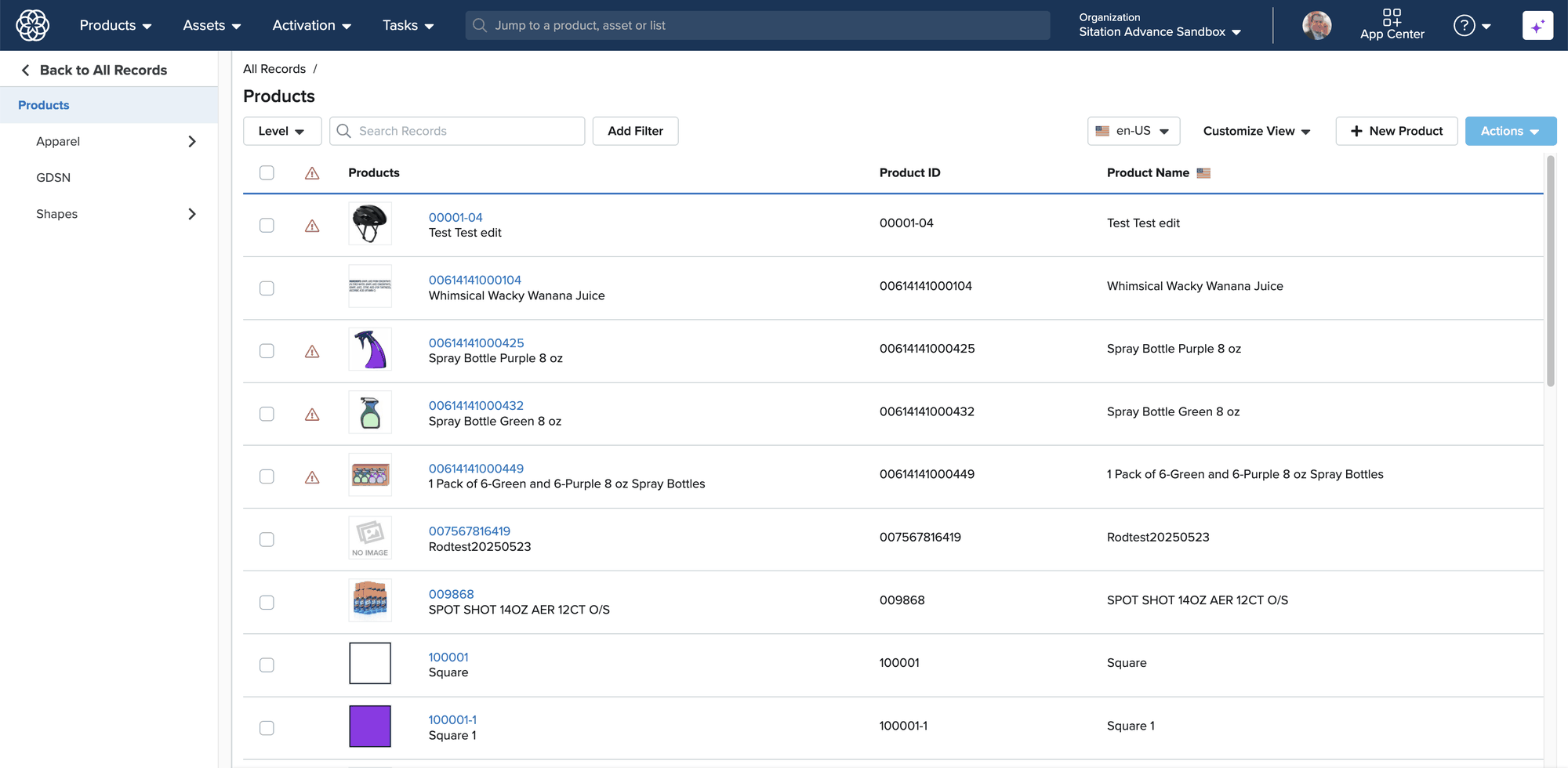
One product record
Product information is organized “around a common data model and governance structure” so every team works from the same source (Salsify PIM). See what data you can manage in Salsify.
A version for each channel
Teams can manage different versions of product information for each channel or region, and trace how content was changed to meet each destination’s requirements (Salsify PIM).
Workflows and approvals
A no-code workflow builder and a task workspace manage who creates, enriches, reviews and approves content (Salsify PIM).
Retailer readiness
Readiness Reports show each retailer’s attribute requirements and what is missing before content is submitted (Salsify syndication).
Syndication
Salsify calls its PIM “natively built with content syndication and direct publishing options”. It maps core data to retailer attribute sets, transforms it for each destination and validates it before sending (Salsify syndication). Our article lists the retailers Salsify publishes to.
Integrations and API
Salsify offers an API framework, webhooks and ready-made integrations for ERP and commerce platforms such as SAP, Salesforce, Adobe Commerce, Shopify and Oracle (Salsify PXM). See what you can build with the Salsify API.
AI features
The Salsify Intelligence Suite brings AI into Salsify workflows, including suggested mappings for new channels (Salsify syndication).
Which of these you get depends on your subscription. Syndication, enhanced content, the GDSN data pool and analytics are separate products in the platform, so check what your quote includes.
Who chooses Salsify PIM
Salsify is chosen most often by brands and manufacturers that sell through other companies’ shelves. Salsify names five industries on its own site: industrials, CPG, fashion and beauty, food and beverage, and home goods (Salsify PXM). These are the ones where Sitation has an industry practice.
Consumer packaged goods
One packaging change can touch hundreds of retailer listings, images and GDSN records.
Sitation example: Bush Brothers & Company
Grocery and bev-alc
Retailers and distributors each need product facts, compliance details and images in their own format.
Sitation example: Share A Splash Wine Co.
Furniture and home goods
Large assortments with many options, dimensions and images sell through retail partners and marketplaces.
Sitation example: Hudson & Canal
Industrial manufacturers
Technical specifications and documents have to reach distributors and national accounts accurately.
Sitation example: Warren Rupp
Apparel and fashion
Collections, colorways and sizes change every season, across wholesale partners and direct channels.
Who Salsify PIM fits, and who it doesn’t
Salsify is built for companies that publish product content to many places. That strength matters more for some businesses than others. This is our reading, from implementing Salsify and three other platforms.
Salsify PIM fits well when
- You sell through many retailers and marketplaces, and each one has its own content requirements.
- You want PIM and syndication in one cloud platform, not two tools to connect.
- Your eCommerce, brand and content teams will run the platform day to day.
- You need GDSN alongside retailer content, as many consumer goods and grocery suppliers do.
Look at alternatives when
- You need to govern product data together with customer, supplier or location data. Look at a multidomain MDM platform such as Stibo Systems.
- You want to start self-hosted or open source. Akeneo offers a free Community Edition.
- GDSN and trading-partner data exchange are the center of the program. Compare Syndigo.
- You sell mostly through your own site, with few external channels. Built-in retailer syndication will matter less to you.
A quick self-assessment
Check each statement that is true for your company. This is a rule of thumb from our projects, not a score from Salsify. Nothing you check is sent or stored.
Check the statements that apply to you.
A fit check narrows the field. It does not replace a selection process. Our guide on how to choose a PIM covers requirements, RFPs and scripted demos on your own data.
What Salsify PIM costs
Salsify does not publish a price list. It is sold as a subscription and quoted for each customer, and the price follows scale and complexity:
- SKUs and product recordsHow many products and variants you manage.
- CategoriesEach product category brings its own attributes and content requirements.
- ChannelsThe number of retailers, marketplaces and sites you publish to.
- IntegrationsConnections to your ERP, DAM, commerce platform and supplier feeds.
- Seats, support and add-onsThe people who log in, the support agreement and extras such as analytics and enhanced content.
The subscription covers the software. Setting it up is separate project work that grows with the same factors. Some customers get their Salsify license and the build, with an implementation partner like Sitation, for around $50K. The total rises with more SKUs, categories, channels or complex integrations. Our article on how Salsify pricing works goes through each driver. Confirm current pricing with Salsify for your scope.
How a Salsify PIM implementation works
A Salsify implementation follows the same four phases as any PIM project, described in our PIM implementation guide:
Discover
Agree the outcomes, map data flows and integrations, and set the scope of the first release.
Design
Model product types, properties, workflows and governance, and get the model approved.
Build and migrate
Configure Salsify, build integrations and load cleansed data in increments.
Launch and adopt
Train each role, go live, support the first weeks and hand over to the team that will run it.
How long it takes depends less on Salsify than on three things: how many systems it must connect to, the condition of your source data and how many channels the first release serves.
One example from a Sitation project:

Warren Rupp, part of IDEX Corporation, chose Salsify after a structured evaluation led by Sitation. We launched Salsify PIM connected to JD Edwards, Bynder and SAP Commerce, and the model became IDEX’s preferred PIM approach.
- 4 monthsfrom kickoff to a live Salsify PIM
- 54IDEX subsidiaries with Salsify as the preferred PIM
For how we plan and deliver a rollout, see Salsify implementation services.
Running Salsify after launch
Go-live starts the platform’s working life. Someone has to add attributes and channels, respond to retailer requirement changes, support users and watch data quality. Companies usually run Salsify in one of three ways: an in-house administrator and data stewards, a partner under an agreed scope, or a mix of both.
Two examples from programs Sitation supports:

Sitation Managed Services took ownership of Salsify and GDSN workflows, with syndication centralized in one place.
- 100+retailer and trading-partner destinations

Sitation built an AI translation workflow inside Salsify. ShelterLogic’s teams now manage French-Canadian and Spanish translations themselves.
- 2 languagestranslated in-house, without an agency
If you want a partner to run the platform, see Salsify managed services. For engineering inside your own team, see Salsify forward deployed engineers. To create and enrich product content inside Salsify, see Plezio Draft for Salsify.
Salsify PIM compared with Akeneo, Stibo Systems and Syndigo
All four platforms manage product information, but they start from different places. This summary comes from our PIM platform comparison, which describes each platform against the same seven criteria from the vendors’ own pages. There is no ranking.
| Platform | Starting point | Syndication | Public pricing |
|---|---|---|---|
| Salsify | PIM with built-in syndication and publishing | Retailer network with requirement validation; GDSN data pool | Not published |
| Akeneo | PIM, with a free open-source Community Edition | Akeneo Activation to 500+ retailers and marketplaces | Packages compared publicly; higher packages quoted |
| Stibo Systems | Multidomain MDM with a product experience suite | Product Data Syndication with retailer-rule validation; GDSN through PDX Syndication and 1WorldSync | Not published |
| Syndigo | PIM and MDM with syndication and a GDSN data pool | Thousands of retailers, marketplaces and distribution partners; GS1-certified GDSN data pool | Not published |
For platforms beyond these four, see Salsify’s competitors and alternatives.
How Sitation helps with Salsify
Sitation is the #1 global provider of Salsify services and Salsify’s first Platinum Solution Partner, with more than 200 Salsify implementations and more than 60 active Salsify certifications. We help companies select the platform, implement it, connect it to the systems around it and run it after launch. Our Salsify partner page has the details.
Salsify awards and honors
- 2023 to 2026Platinum Partner status, four years running
- 2026Salsify Transformer Award winners with Sitation: Kids2 and Ultimate Products
- 2026Five Sitation clients nominated for the Salsify Transformer Awards
- 2023Salsify’s first Platinum Partner
- 2023Top Regional Systems Integrator
- 2023Partner Innovation Award
- 2022Salsify Partner Hackathon winner
- 2022Partner Growth Award
The simplest way to start is a free Salsify program review: a 45-minute working session with a Salsify architect. We look at your catalog, syndication and team workload with you, and agree on the first priorities. We reply within one business day.
Frequently asked questions
What is Salsify PIM used for?
Salsify PIM is used to keep product information in one system of record, enrich it with workflows and approvals, and publish it to retailers, marketplaces and a company’s own sites. Brands and manufacturers use it to launch products faster and keep content accurate on every channel.
Is Salsify a PIM or a PXM?
Both. Salsify calls its platform product experience management (PXM). PIM is the system of record inside it, and the platform adds syndication, enhanced content, a GDSN data pool, digital shelf analytics and AI features around that record.
How much does Salsify PIM cost?
Salsify does not publish prices and quotes each customer. The price depends on scale and complexity: SKUs, categories, channels, integrations, seats, support and add-ons. Our article on how Salsify pricing works explains each driver. Confirm current pricing with Salsify.
Does Salsify PIM include syndication?
Salsify describes its PIM as natively built with content syndication and direct publishing options. Syndication, enhanced content and the GDSN data pool are separate products in the platform, so check which ones your subscription includes.
Does Salsify support GDSN?
Yes. Salsify runs a GDSN data pool as part of its platform. See our GDSN implementation services for how data readiness and data-pool connections are planned.
How long does a Salsify PIM implementation take?
There is no standard duration. It depends on how many systems Salsify must connect to, the condition of your source data and how many channels the first release serves. Sitation launched Salsify PIM for Warren Rupp in four months with a tightly scoped first release.
Do I need an implementation partner for Salsify?
Not always. A team with PIM experience and available time can implement Salsify with Salsify’s own services. A partner helps most when the data model, integrations or retailer syndication are complex. Our guide on how to find a top Salsify partner explains what to check.
What are the alternatives to Salsify PIM?
Common alternatives include Akeneo, Stibo Systems and Syndigo, and buyers also look at Inriver, Plytix and Productsup. See Salsify’s competitors and our PIM platform comparison.
-
 Salsify, Akeneo, Stibo Systems and Syndigo: how the PIM platforms differ
A fair comparison of four PIM platforms on data model, syndication, integration, governance, AI, pricing model and fit, sourced from vendor pages and dated. Read the guide
-
 How to find a top Salsify partner
What Salsify’s partner tiers mean, a buyer’s checklist, questions to ask and how to verify a Salsify partner’s claims in Salsify’s own directory. Read the guide
-
 What is a Forward Deployed Engineer?
What a forward deployed engineer (FDE) is, what the role involves, the skills it takes, how it compares with other roles, and when a company needs one. Read the guide
Get more from your Salsify program
Sitation was Salsify’s first Platinum Solution Partner and has completed more than 200 Salsify implementations. Tell us what is slowing your team down and we will suggest where to start.
Our Salsify partner servicesSalsify implementation servicesSalsify managed services